
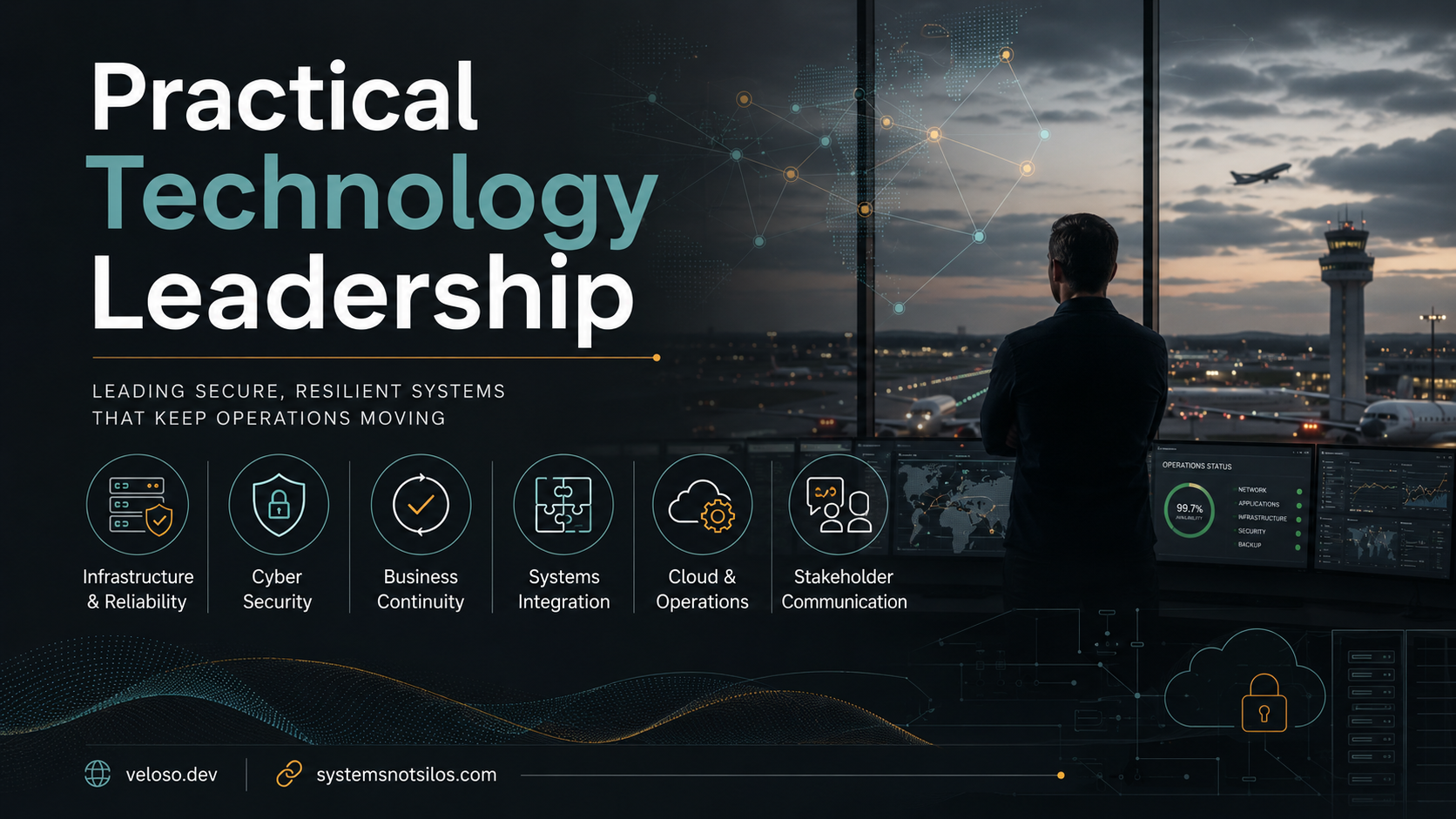
Technology leadership still needs to be practical.
In many organisations, the role of IT leadership has changed significantly.
It is no longer enough to simply “keep the systems running,” but it is also not enough to sit too far above the work and only talk in terms of frameworks, roadmaps, and abstract strategy.
The best technology leaders, especially in operational environments, need to sit somewhere in the middle.
Close enough to the business to understand risk, cost, continuity, people and priorities.
Close enough to the technology to understand infrastructure, systems, integrations, security, data, platforms and practical delivery.
And close enough to operations to know that a system outage is not an academic problem. It affects real people, real customers, real assets, real schedules and real business outcomes.
This is especially true in environments such as logistics, transport, aviation, infrastructure, utilities, ports, airports and other operational businesses where technology is not just a support function. It is part of the operating model.
A good Head of IT or technology leader in this type of environment needs to bring together several disciplines:
Infrastructure and systems reliability
The business needs stable networks, servers, devices, cloud platforms, applications, identity systems, backups, monitoring and support processes. These are not glamorous things, but they are the foundations on which everything else depends.
Cybersecurity and business continuity
Security is not just a technical checklist. It is a business resilience discipline. The question is not only “are we protected?” but also “can we continue operating, recover quickly, protect data and make informed decisions under pressure?”
Practical project delivery
Technology leaders must be able to deliver ICT components of broader business projects. That means understanding scope, dependencies, vendors, stakeholders, budgets, risks, environments, timelines and operational impact.
Systems integration and data flow
Modern organisations rarely run on one system. They run on many systems connected through APIs, data feeds, manual workarounds, legacy platforms, cloud services and vendor products. The quality of those integrations often determines whether the business has visibility, confidence and control.
Communication with non-technical stakeholders
One of the most important responsibilities of IT leadership is translating technical complexity into practical business advice. Senior leaders do not need jargon. They need options, risks, trade-offs, costs and clear recommendations.
Hands-on credibility
A practical technology leader does not need to write every line of code or configure every server, but they should understand enough to ask the right questions, challenge weak assumptions, support their team and make decisions grounded in reality.
That balance has shaped much of my career.
I have worked across software engineering, solution architecture, systems integration, infrastructure support, cloud platforms, operational systems, logistics technology, stakeholder management and engineering leadership.
In logistics and operational environments, I have seen firsthand how important it is for technology to be reliable, understandable and aligned with the business. A beautifully designed system that does not support the operation is not a success. A technically clever integration that creates more manual work is not progress. A secure platform that people cannot use properly will eventually become a risk.
Technology leadership should not be disconnected from the floor, the field, the customer, the operator, the finance team, the executive team, or the person who gets the phone call when something breaks.
The old fundamentals still matter:
keep systems reliable,
document properly,
protect the business,
support the users,
respect operational reality,
make sensible decisions,
and deliver technology that serves the organisation rather than impressing only the technologists.
The newer expectations also matter:
cloud, automation, cyber security, data governance, interoperability, digital platforms, scalable architecture and continuous improvement.
The real value is in bringing both together.
That is where I believe strong IT leadership sits today: practical, secure, operationally aware, technically credible and business aligned.
#TechnologyLeadership #HeadOfIT #ICTLeadership #ITManagement #Infrastructure #CyberSecurity #BusinessContinuity #SystemsIntegration #CloudComputing #DigitalTransformation #OperationalTechnology #EnterpriseTechnology #AviationTechnology #LogisticsTechnology #SoftwareArchitecture #SolutionsArchitecture #EngineeringLeadership #SystemsNotSilos #VelosoDev

