
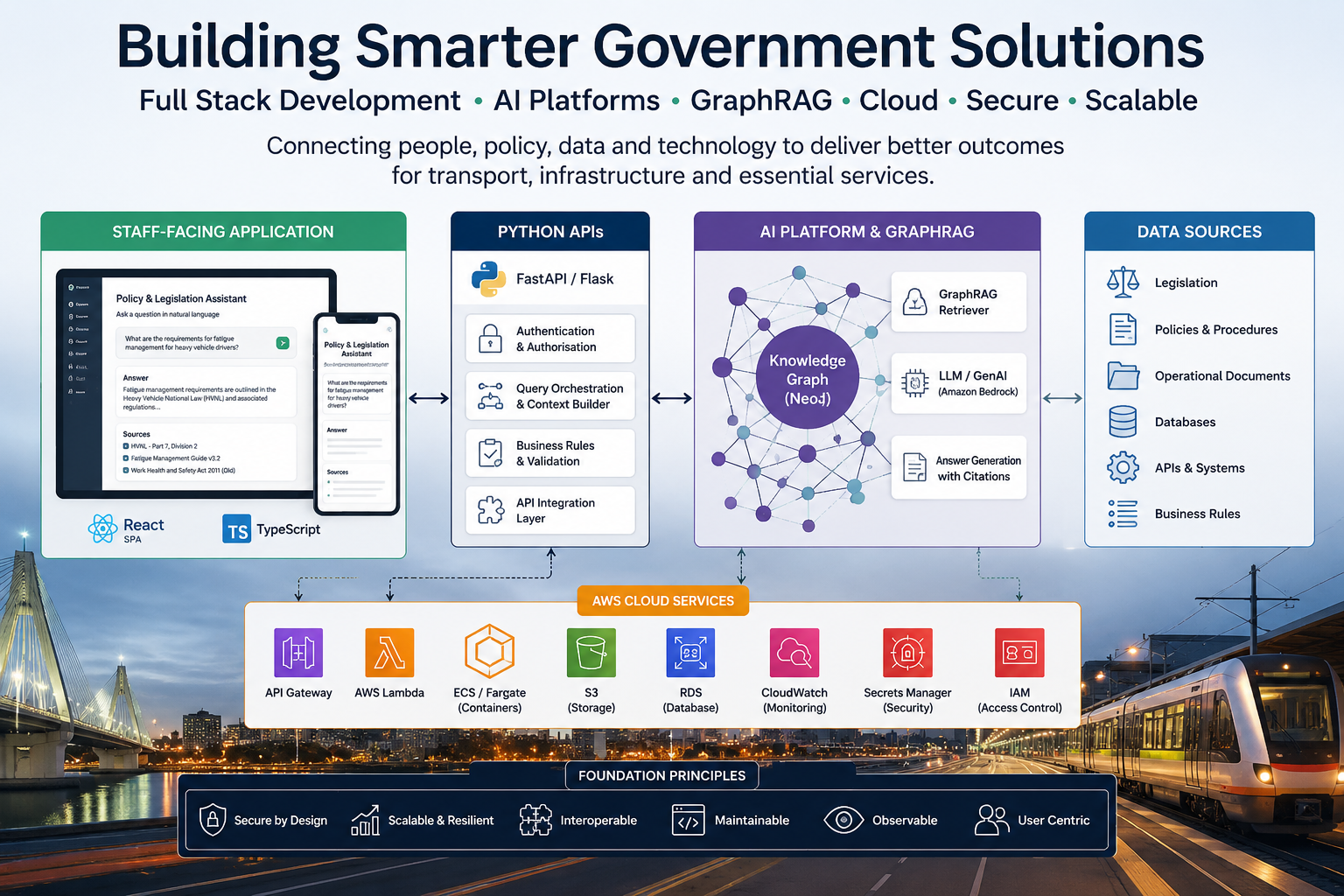
Full Stack Development, GraphRAG, and the Next Layer of Government Digital Services
Building software for government, transport, infrastructure, and essential services is not just about writing code.
It is about turning complex rules, operational knowledge, legislation, policies, data, and stakeholder requirements into systems that people can actually use.
That is why I find the intersection of full stack development, AI platforms, GraphRAG, knowledge graphs, and public-sector digital services so interesting.
For many years, enterprise systems were built around forms, tables, reports, and workflows. Those things are still important. Good software still needs clean interfaces, reliable APIs, strong security, proper testing, maintainable architecture, and production discipline.
But we are now entering a stage where internal staff should not always need to know where every rule lives, which policy document applies, or which system contains the answer.
A well-designed platform should help them ask better questions and receive useful, traceable, context-aware answers.
That is where technologies such as React, Python APIs, AWS, Docker, REST integration, structured and unstructured data processing, RAG, GraphRAG, and knowledge graphs become powerful when used properly.
Not as gimmicks.
Not as replacement for good engineering.
But as an additional layer on top of solid architecture.
The real challenge is not simply connecting an AI model to documents. The real challenge is designing the surrounding system well enough that it is useful, governed, secure, maintainable, and trusted.
For staff-facing applications in government, transport, utilities, logistics, and infrastructure, that means thinking carefully about:
• how policies and business rules are represented
• how legislation and operational documents are indexed
• how users ask questions in natural language
• how answers are grounded in reliable sources
• how structured and unstructured data are connected
• how APIs expose capability safely
• how frontend workflows remain simple and usable
• how cloud services scale without becoming fragile
• how security, auditability, and maintainability are preserved
• how architects, SMEs, developers, and delivery teams work together
This is where traditional software engineering still matters.
A good React interface matters.
A clean Python API matters.
A well-designed data model matters.
A secure AWS deployment matters.
A properly documented integration matters.
A reliable CI/CD pipeline matters.
And above all, understanding the business context matters.
In logistics and infrastructure environments, I have seen how much value is created when technical systems reduce manual interpretation, connect scattered information, and give operational teams better visibility. A task that once required searching emails, documents, spreadsheets, legacy systems, and human memory can often be transformed into a guided workflow or intelligent interface.
That is the kind of engineering I enjoy most.
Practical systems.
Useful automation.
Strong integration.
Clear user experience.
Technology that respects the complexity of the organisation rather than pretending it does not exist.
AI will not fix weak architecture. But when AI is combined with disciplined full stack development, good data integration, cloud engineering, and proper stakeholder engagement, it can become a serious productivity layer for large organisations.
That is especially true in public-sector and essential-services environments, where the cost of confusion, delay, or inconsistent decision-making can be high.
The future of enterprise software is not only about smarter models.
It is about better systems around those models.
#FullStackDevelopment #ReactJS #Python #FastAPI #Flask #AWS #GraphRAG #RAG #KnowledgeGraphs #ArtificialIntelligence #GenerativeAI #SoftwareEngineering #SoftwareArchitecture #SolutionsArchitecture #SystemsIntegration #CloudEngineering #APIDesign #Docker #DevOps #GovernmentTechnology #TransportTechnology #InfrastructureTechnology #DigitalTransformation #EnterpriseArchitecture #DataIntegration #StructuredData #UnstructuredData #UserExperience #PublicSectorTechnology #velosodev #systemsnotsilos #gumtreedev

