
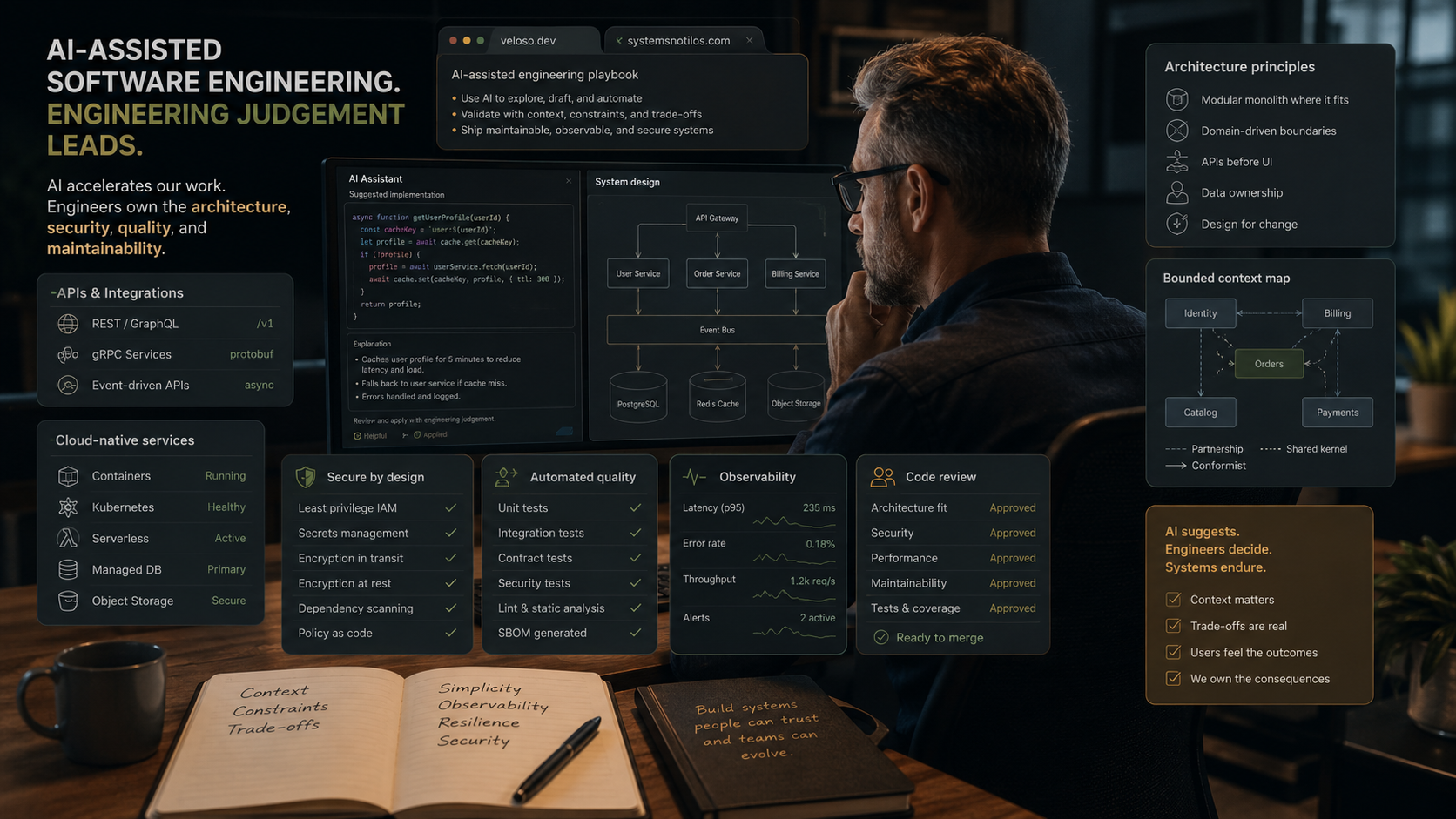
AI-Assisted Engineering Still Needs Real Engineering Judgement
AI can help engineers move faster, but speed alone is not software engineering.
The real test is whether the system remains understandable, secure, testable, maintainable, and useful after the first version is shipped.
I have been using AI tools more and more in my day-to-day engineering work, including ChatGPT, Claude, GitHub Copilot, Cursor, Codex, and Gemini. They are genuinely useful for scaffolding, refactoring, writing first-pass tests, reviewing code, exploring libraries, preparing documentation, and thinking through implementation options.
But I do not treat AI output as finished work.
I treat it more like a fast assistant that still needs review, context, correction, and engineering judgement.
A generated solution can look clean and still miss the domain problem.
It can compile and still be insecure.
It can pass a simple test and still fail under real production conditions.
It can use a fashionable pattern where a simple function would have been easier to maintain.
That is why the fundamentals still matter.
Good software still needs clear boundaries, sensible data models, well-designed APIs, useful tests, readable code, secure configuration, predictable error handling, observability, and documentation that helps the next person understand why decisions were made.
This becomes even more important when building AI-enabled tools, agentic workflows, cloud-native services, and internal automation platforms.
The hard part is rarely just producing code.
The hard part is understanding the workflow, knowing what should be automated, protecting data quality, handling failure states, keeping humans in the loop where needed, and making sure the solution fits into the wider system.
In logistics, cloud, cyber, enterprise systems, and operational platforms, software does not live in isolation. It connects to people, processes, APIs, databases, infrastructure, compliance expectations, and business risk.
That is where engineering maturity matters.
AI can accelerate delivery, but it does not remove responsibility.
The engineer still owns the architecture.
The engineer still owns the trade-offs.
The engineer still owns the quality.
The engineer still owns the security implications.
The engineer still owns whether the system can be operated and changed six months later.
The future of software engineering is not simply about generating more code.
It is about building better systems, with better judgement, using better tools.
That is the kind of engineering work I enjoy most: practical systems that solve real problems, supported by strong fundamentals and improved by thoughtful automation.
More thoughts on engineering, architecture, and interoperability at veloso.dev and systemsnotsilos.com.
#SoftwareEngineering #SoftwareArchitecture #SolutionsArchitecture #ArtificialIntelligence #AIEngineering #PlatformEngineering #CloudInfrastructure #DistributedSystems #Interoperability #DevSecOps #WorkflowAutomation #EngineeringLeadership #DigitalLogistics #SmartPorts #CyberSecurity #SystemIntegration #TechnologyStrategy #DeveloperTools #VelosoDev #SystemsNotSilos #GumtreeDev

