
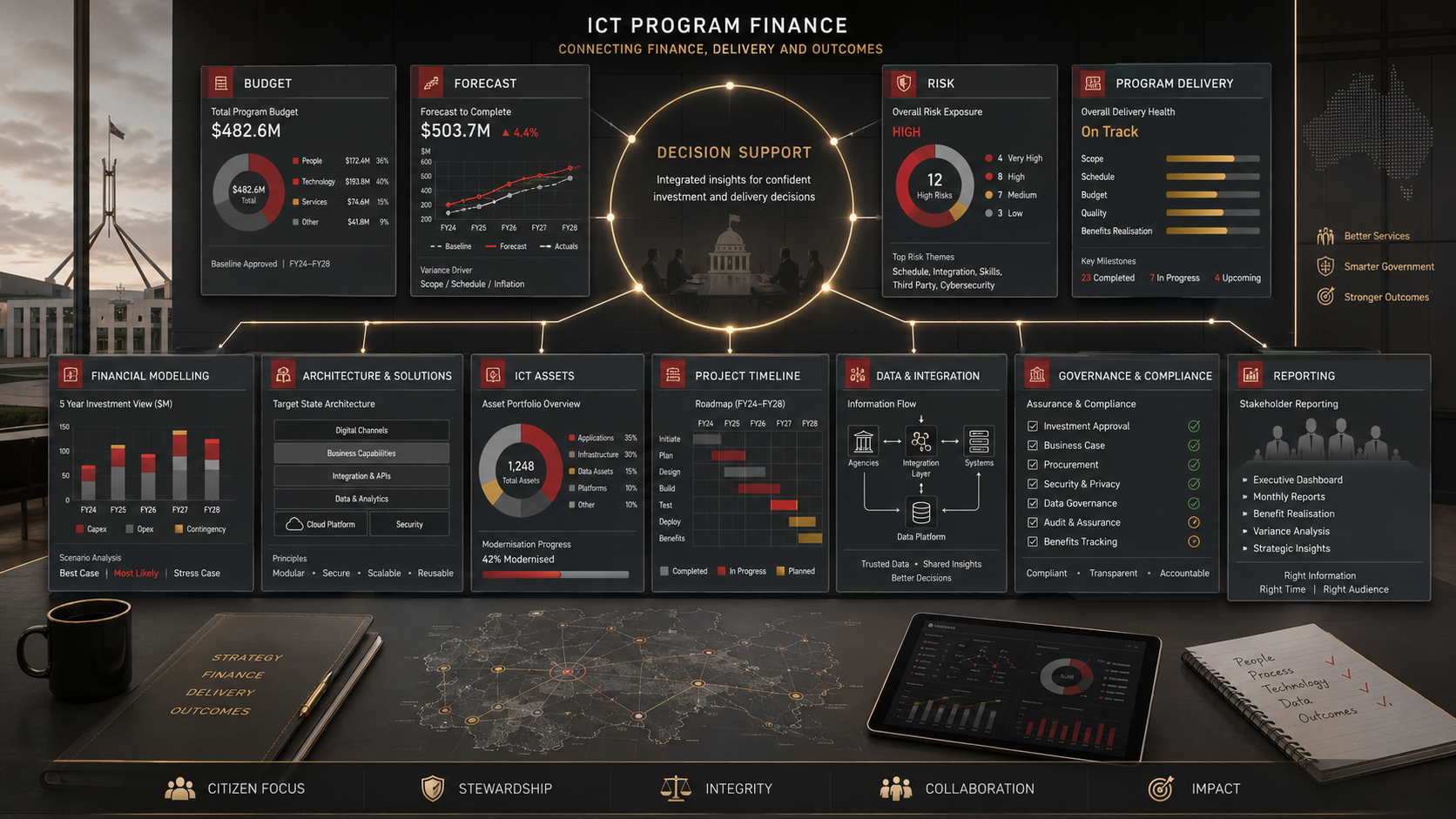
ICT Program Finance Is Really About Decision Confidence
Large ICT programs rarely fail because one spreadsheet was wrong.
They usually fail because finance, delivery, architecture, risk, and operational reality drift apart.
That is why program finance in digital transformation is not just about reporting numbers after the fact. It is about building decision confidence while the work is still moving.
In complex ICT programs, finance needs to understand more than budget lines.
It needs to understand:
What work is actually being delivered
Which costs relate to sustainment, enhancement, or new capability
Where operational funding ends and capital investment begins
Which risks are likely to become financial pressure
Which project assumptions no longer match delivery reality
Which data can be trusted before it reaches executives, boards, committees, or government reporting cycles
This becomes even more important in large public-sector digital programs, where multiple agencies, delivery partners, funding streams, vendors, and committees may all depend on the same financial view.
A useful financial model for an ICT program should not be treated as a static spreadsheet.
It should behave more like a living control system.
It should help program leaders test scenarios, understand current-year and outer-year impacts, compare planned versus actual delivery, diagnose cost movement, and explain risk in plain language.
The best program finance work sits close to delivery without becoming lost in delivery.
It asks practical questions:
Are we capitalising the right kind of work?
Are we treating support, maintenance, enhancement, and new capability correctly?
Can we explain the movement between forecast and actuals?
Do our financial reports reflect what is happening in the project teams?
Are we giving executives enough context to make a decision, not just enough numbers to fill a pack?
From my own ICT background, I have seen how valuable this bridge can be.
In logistics platforms, eCommerce environments, SaaS systems, cloud services, API programs, data migrations, and automation projects, the same pattern appears again and again: technical activity must eventually become management information.
A workflow improvement is not just a workflow improvement.
It affects labour effort, timing, reporting, operational throughput, support load, future maintenance, and sometimes the way an asset should be understood over its lifecycle.
That is where ICT program finance can add real value.
Not by replacing accountants with technologists.
Not by replacing technologists with accountants.
But by making sure the project finance view is grounded in what is actually being built, changed, sustained, retired, integrated, and governed.
In older project environments, finance often arrived at the end of the month.
In modern digital programs, finance needs to be part of the control rhythm.
Good program finance helps leaders see clearly.
Better program finance helps them act earlier.
#ICTProgramManagement #ProgramFinance #DigitalTransformation #ProjectFinance #FinancialModelling #DataAnalysis #GovernmentTechnology #DigitalGovernment #ICTGovernance #TechnologyStrategy #ProjectManagement #CloudInfrastructure #SystemIntegration #InformationArchitecture #SoftwareArchitecture #SolutionsArchitecture #DigitalDelivery #VelosoDev #SystemsNotSilos #GumtreeDev

