
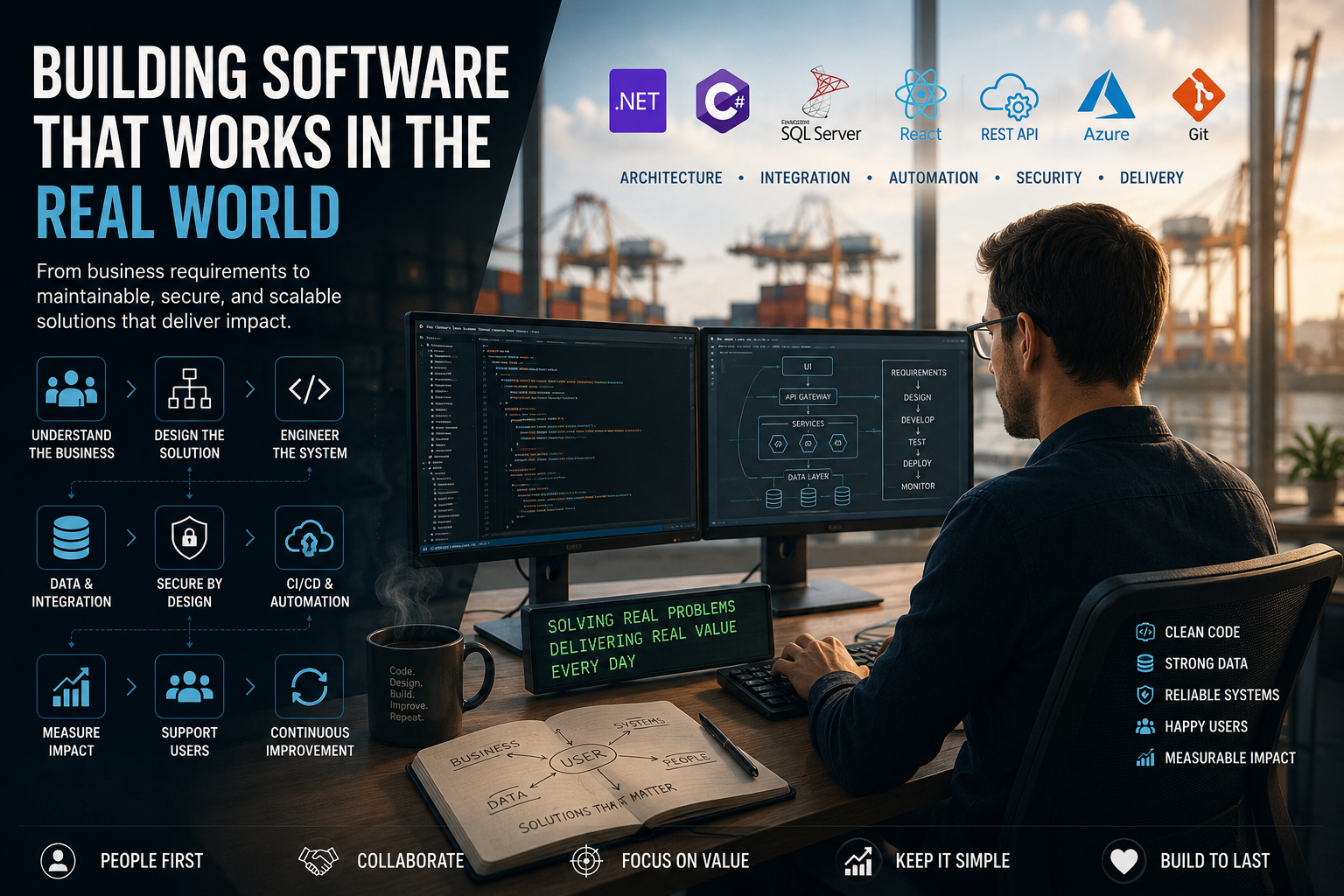
Good software is not just written. It is translated.
One of the most important lessons I have learned across software engineering, technical leadership, logistics platforms, payments, eCommerce, operational systems, and enterprise integrations is that the best systems rarely begin with code.
They begin with understanding.
Understanding the business process.
Understanding the user.
Understanding the data.
Understanding the legacy system that still keeps the organisation running.
Understanding the risk of changing something that people depend on every day.
That is especially true when building systems for essential services, regulated environments, public-facing operations, legal services, logistics, finance, or any organisation where software is not just a convenience, but part of how people get access to support, service, information, and decisions.
A senior developer’s job is not simply to pick a framework and start coding. It is to translate requirements into software that can actually survive the real world.
That means being able to move between several layers at once:
Business requirements.
Technical specifications.
Database design.
APIs.
Front-end architecture.
Back-end services.
Security.
Testing.
CI/CD.
Documentation.
Production support.
Stakeholder communication.
Maintainability.
A well-designed application is not just about what works today. It is about what can be understood, tested, changed, supported, and trusted tomorrow.
In my own career, I have often found myself working in that middle space between business stakeholders and technical teams. Sometimes the task has been to modernise or extend an existing system. Sometimes it has been to design APIs. Sometimes it has been to improve database processes. Sometimes it has been to reduce manual work through automation. Sometimes it has been to guide developers, testers, business analysts, vendors, and operational users toward a practical delivery outcome.
The technology stack matters, of course.
C#.
.NET.
SQL Server.
REST APIs.
JavaScript.
React.
Angular.
Node.js.
PHP.
Python.
CI/CD.
Git.
Cloud platforms.
Testing frameworks.
Application servers.
But the older I get in this industry, the more I value the discipline behind the stack.
Clear specifications.
Simple architecture.
Clean data models.
Readable code.
Proper version control.
Documented decisions.
Repeatable deployments.
Defensive debugging.
Respect for legacy systems.
Pragmatic modernisation.
Good communication with users.
I have seen firsthand how much value can be created by improving an existing workflow rather than replacing everything for the sake of novelty. In one environment, automation and redesign reduced a large operational process from several days to only a few hours. In another, better workflow and system design reduced booking-related effort from around ten minutes to one or two minutes. Those outcomes were not achieved by technology alone. They came from understanding the business problem properly, then designing software around that reality.
That is why I still believe strongly in practical full stack engineering.
Not abstract engineering.
Not architecture detached from delivery.
Not code written without business context.
Practical engineering means being close enough to the users to understand what matters, close enough to the code to know what is realistic, and experienced enough to make decisions that will not punish the next person who has to maintain the system.
For me, a strong senior full stack developer should be able to:
Translate business requirements into technical specifications.
Design front-end and back-end solutions that fit the actual operating environment.
Build and maintain database-driven applications.
Create APIs that are understandable and reliable.
Work with analysts, stakeholders, developers, testers, and operations teams.
Debug complex issues patiently and methodically.
Document systems well enough that others can support them.
Guide junior and mid-level developers without taking the keyboard away from them.
Respect legacy systems while still improving them.
Deliver software with care, not just speed.
There is a traditional side to good software engineering that I think still matters deeply.
Know your users.
Know your data.
Write things down.
Test before you deploy.
Use source control properly.
Keep the system maintainable.
Do not overcomplicate what should be simple.
Do not underestimate the value of a clear specification.
Do not forget that every production system eventually becomes someone else’s legacy system.
The best developers I have worked with were not only clever. They were dependable. They could communicate. They could listen. They could simplify. They could debug under pressure. They could mentor others. They could turn uncertain requirements into working, maintainable software.
That is the kind of engineering I value.
And it is the kind of engineering I try to bring into every system I work on.
#SoftwareEngineering #FullStackDevelopment #DotNet #CSharp #SQLServer #WebApplications #APIDesign #DatabaseDesign #TechnicalLeadership #LegacyModernisation #CICD #DevOps #ApplicationArchitecture #SystemsIntegration #BusinessAnalysis #TechnicalDocumentation #SoftwareArchitecture #StakeholderEngagement #SecureSoftware #MaintainableCode #velosodev #systemsnotsilos #gumtreedev

