
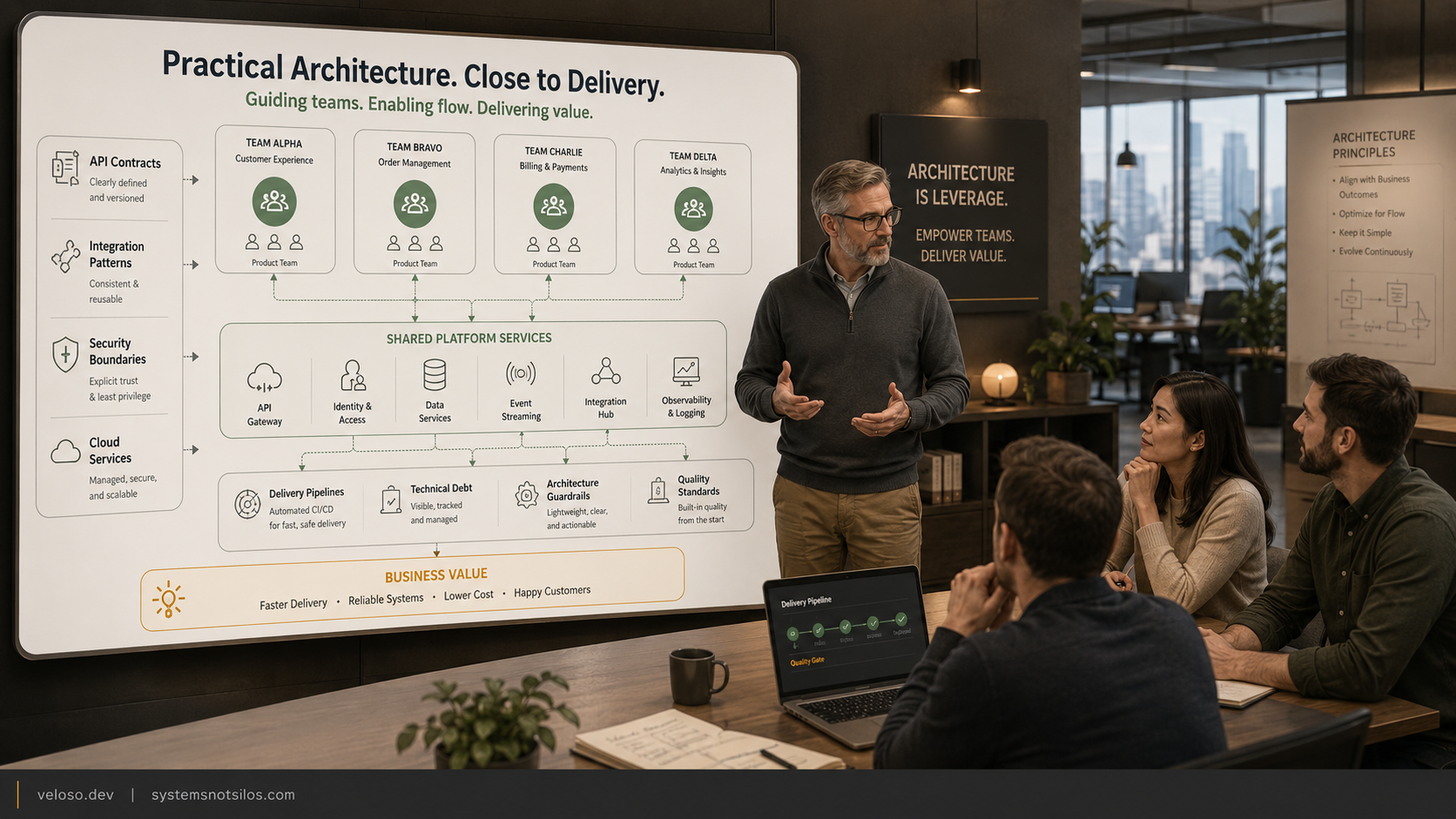
Software Architecture Is Most Valuable When It Stays Close to Delivery
Software architecture should not live in a document that gets handed over and forgotten.
The best architecture work I have seen, and the kind I enjoy doing most, sits close enough to delivery to remain useful.
That does not mean architects should micromanage engineers or turn every implementation detail into a design committee. It means the architect remains accountable for the solution’s integrity while giving delivery teams room to execute.
In practical terms, that usually means staying involved through the important decision points:
Clarifying the business problem before designing the technology.
Understanding the users, stakeholders, constraints, risks and operational realities.
Defining the major components, integration patterns, API contracts, data flows, security considerations and deployment direction.
Helping teams make trade-offs between speed, maintainability, cost, resilience and scalability.
Reviewing decisions that are hard to reverse before they become expensive to fix.
Then, when the design intent is clear, good architecture steps back from controlling every task and stays close enough to unblock delivery.
This is especially important in portfolio-level environments where multiple teams are building across shared systems. The hard part is rarely just choosing a tool. It is understanding how a decision made by one team affects another team, another customer journey, another integration, another deployment pipeline, or another security boundary.
That is where architecture earns its value.
When I prioritise architectural work or technical debt across teams, I usually start with a simple order of concern:
Protect production first.
Address security and compliance risk early.
Unblock committed delivery.
Resolve cross-team dependencies before they slow everyone down.
Prioritise decisions that are hard to reverse, such as data models, integration contracts, cloud patterns, API boundaries and deployment architecture.
Align improvement work with measurable business value, not just technical preference.
This is why I believe a strong software architect needs more than technical depth. They also need delivery judgement.
They need to know when to stay involved and when to step away.
They need enough engineering background to speak credibly with developers, enough architecture discipline to see across systems, and enough stakeholder awareness to understand why the business cares.
A useful architect does not only ask, “Is this technically correct?”
They also ask:
Can the team build it?
Can the business support it?
Can it evolve without becoming fragile?
Can it be secured, monitored and operated properly?
Will this decision still make sense when another team depends on it?
That balance between architecture, engineering and delivery is where I think modern software architecture becomes most valuable.
Not ivory-tower design.
Not uncontrolled coding.
Not technology for its own sake.
Just practical, end-to-end solution ownership that helps teams build systems that are secure, maintainable, scalable and fit for the business they serve.
#SoftwareArchitecture #SolutionArchitecture #SoftwareEngineering #SolutionsArchitecture #PlatformEngineering #CloudInfrastructure #AWS #APIDesign #SystemIntegration #DistributedSystems #TechnicalLeadership #EngineeringLeadership #DevSecOps #TechnologyStrategy #ArchitectureAndSystemIntegration #VelosoDev #SystemsNotSilos #GumtreeDev

