
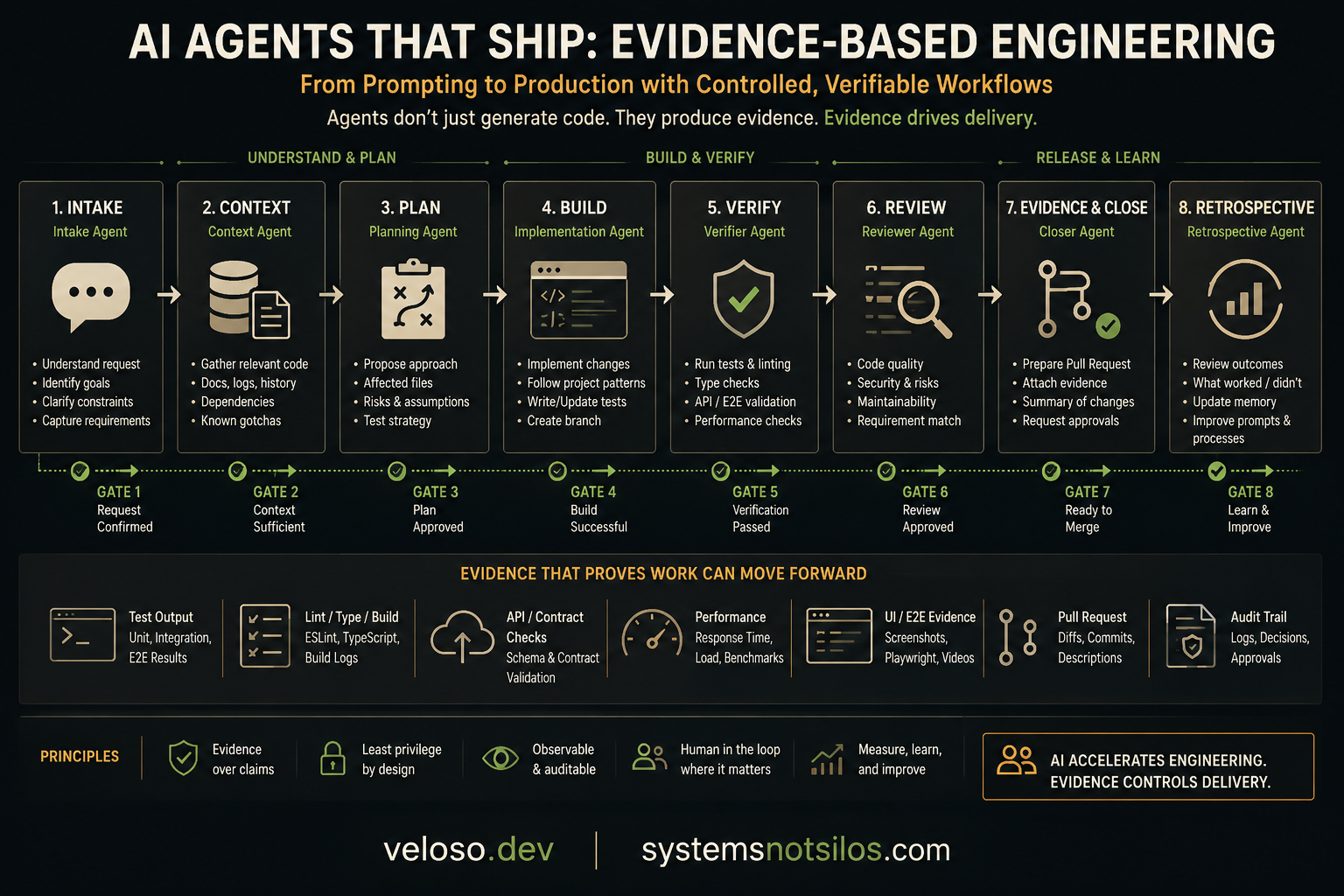
AI Agents That Ship: From Prompting to Evidence-Based Engineering
There is a big difference between using AI to generate code and designing AI-enabled engineering systems that can safely ship software.
That difference is evidence.
A single AI assistant can help write a function, explain an error, create a test, or refactor a component. That is useful, but it is not enough for production engineering. Once AI becomes part of a team workflow, the question is no longer only “can the model produce code?”
The better question is:
Can the system verify that the work is sufficiently correct to move forward?
A mature AI-assisted engineering workflow should not rely on one large prompt and hope. It should be designed like a controlled delivery pipeline.
For example, instead of one agent doing everything, I would break the workflow into clear stages:
An intake agent understands the ticket, issue, or business problem.
A context agent gathers relevant code, documentation, logs, previous decisions, and known project gotchas.
A planning agent proposes the approach, affected files, risks, and test strategy.
An implementation agent makes the change in a branch, following existing project patterns.
A verifier agent runs tests, linting, type checks, API checks, or end-to-end validation.
A reviewer agent checks maintainability, security, duplication, business logic, and alignment with the original requirement.
A closer agent prepares the pull request, attaches evidence, and explains what changed.
A retrospective agent reviews the run and updates small, curated project memory so the same mistakes are less likely to happen next time.
The agents matter, but the gates between them matter more.
A workflow should not move from implementation to review just because an agent says “done.” It should move forward because there is evidence: test output, build logs, API responses, screenshots, Playwright results, code review notes, audit trails, or human approval where required.
This is especially important when designing systems for both human users and AI consumers.
A human-facing application needs usability, validation, feedback, accessibility, and clear workflows.
An agent-facing interface needs structured contracts, predictable schemas, explicit permissions, idempotent operations, safe failure modes, auditability, and strong boundaries around what the agent can and cannot do.
That becomes even more important in domains involving sensitive data, operational workflows, care delivery, compliance, or real-world services. In those environments, AI should not be given broad authority too early. The safer path is to begin with low-risk internal workflows: ticket analysis, test generation, support investigation, documentation, code review assistance, or draft pull requests.
Then measure.
Did it reduce rework?
Did it improve test coverage?
Did it save reviewer time?
Did it create better documentation?
Did it introduce defects?
Did it produce evidence, or only confidence?
The traditional engineering lesson still applies: automation is only valuable when it is reliable, observable, and controlled.
AI does not remove the need for engineering discipline. It increases the need for it.
The teams that get the most value from AI will not be the ones that simply prompt harder. They will be the ones who design better workflows, verification, guardrails, and feedback loops.
AI should accelerate engineering.
Evidence should control delivery.
#ArtificialIntelligence #AIEngineering #SoftwareEngineering #SoftwareArchitecture #PlatformEngineering #DeveloperTools #WorkflowAutomation #DevSecOps #DistributedSystems #APIDesign #SystemIntegration #EngineeringLeadership #TechnologyStrategy #SolutionsArchitecture #VelosoDev #SystemsNotSilos #GumtreeDev
