
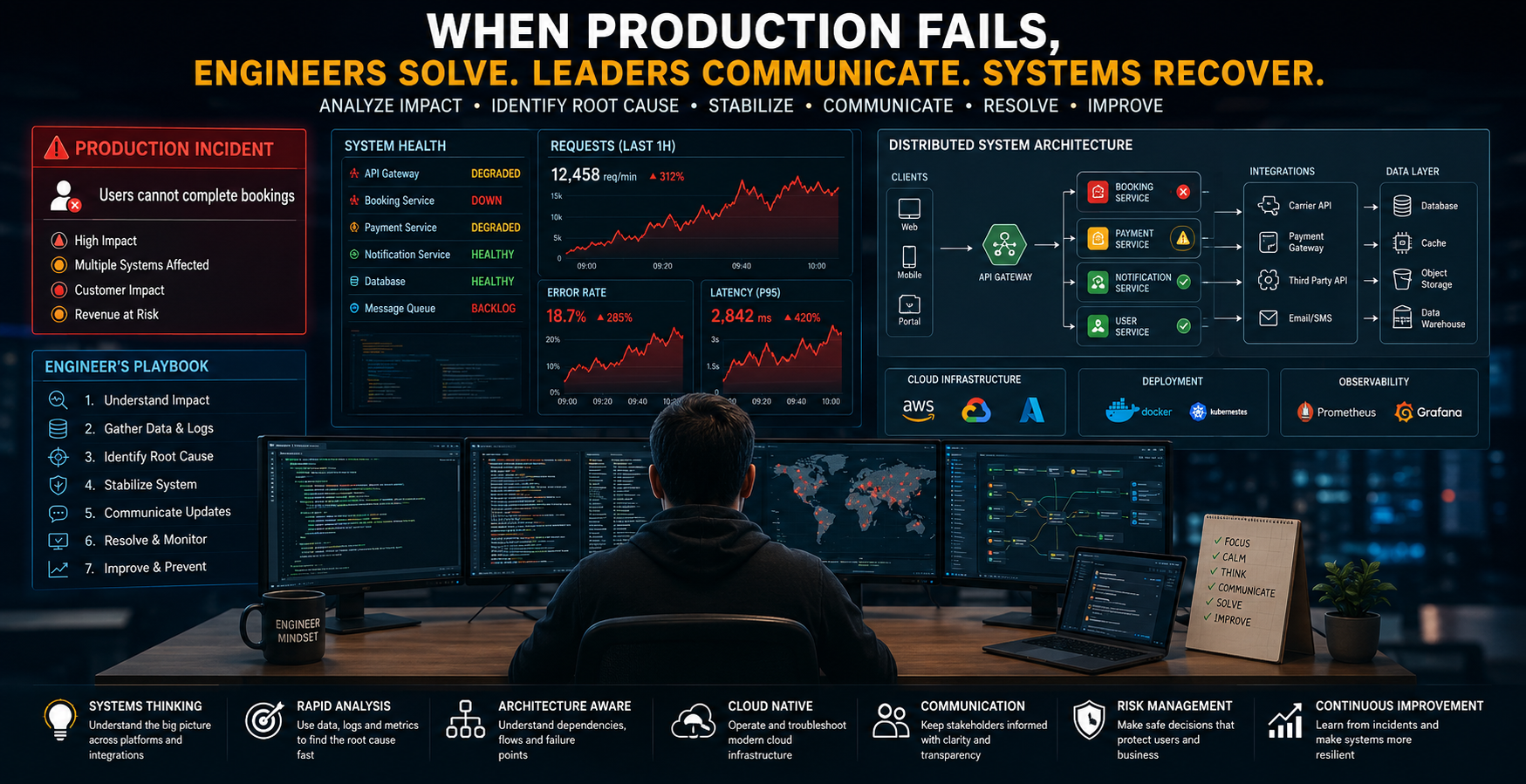
Most Engineers Talk About Code. The Best Engineers Talk About What Happens When Production Fails.
One thing I have learned over the years is that senior engineering is rarely about writing the “perfect” code.
It is about making good decisions when systems become unstable, integrations fail, customers are affected, and the business waits for answers.
That is why so many technical interviews today are moving away from textbook questions and focusing more on realistic engineering scenarios.
Not because companies want memorised answers.
Because they want to understand how engineers think under pressure.
A common scenario might sound something like this:
“Users suddenly cannot complete bookings in production. The platform integrates with multiple APIs, external systems, cloud services, and operational workflows. What do you do?”
At first glance, it sounds like a technical troubleshooting question.
But in reality, it is testing far more than technical knowledge.
It is testing:
• prioritisation
• communication
• operational awareness
• leadership
• systems thinking
• business understanding
• risk management
• debugging discipline
• stakeholder management
• engineering maturity
The strongest engineers I have worked with usually approach these situations calmly and methodically.
Not emotionally.
Not reactively.
Not by randomly changing things in production.
They start by understanding the impact first.
Questions like:
• Is the issue affecting all users or only some?
• Is it frontend, backend, infrastructure, authentication, integration, or data related?
• Did something recently deploy?
• Are external APIs responding correctly?
• Are queues backing up?
• Are logs showing timeouts, rate limits, or authentication failures?
• Is this a functional failure or a performance degradation?
• What is the operational and financial impact if this continues?
Then comes a structured investigation.
Reviewing:
• monitoring dashboards
• logs and traces
• infrastructure health
• deployment history
• integration responses
• database behaviour
• cloud services
• rollback options
• feature flags
• downstream dependencies
And equally important:
communication.
Strong engineers keep stakeholders informed while troubleshooting.
They avoid panic.
They provide realistic updates.
They stabilise first, optimise second.
That mindset becomes even more important in environments involving:
• logistics platforms
• operational technology
• SaaS ecosystems
• cloud-native systems
• payment workflows
• distributed systems
• event-driven architectures
• enterprise integrations
In these environments, production incidents are rarely isolated.
One failed integration can impact bookings, reporting, notifications, workflows, customers, operations teams, transport coordination, finance, or downstream services.
That is why modern engineering is no longer just about development.
It is about understanding systems holistically.
Over the years, working across logistics technology, enterprise integrations, eCommerce systems, cloud environments, APIs, and operational platforms, I have found that the engineers who consistently stand out are usually the ones who combine:
• technical depth
• business awareness
• architecture thinking
• delivery discipline
• operational calmness
• strong communication
• practical problem solving
And increasingly today:
the ability to use AI-assisted engineering responsibly.
AI tools are accelerating workflows for prototyping, troubleshooting, automation, documentation, analysis, and delivery.
But AI does not replace engineering judgment.
It does not replace operational understanding.
And it definitely does not replace accountability in the event of a production incident.
When systems fail, businesses still rely on engineers who can think clearly, communicate properly, understand trade-offs, and make safe decisions quickly.
Technology changes constantly.
Frameworks change.
Cloud providers evolve.
AI tooling grows rapidly.
But disciplined engineering fundamentals still matter just as much today as they did years ago.
Possibly more.
#SoftwareEngineering #EngineeringLeadership #SolutionsArchitecture #TechnicalLeadership #CloudComputing #SystemDesign #DevOps #PlatformEngineering #APIs #DistributedSystems #AI #ArtificialIntelligence #CloudArchitecture #SaaS #NodeJS #ReactJS #AWS #EnterpriseArchitecture #DigitalTransformation #ProductionSupport #EngineeringManagement #OperationalExcellence #Microservices #EventDrivenArchitecture #TechLeadership #SoftwareDevelopment

