
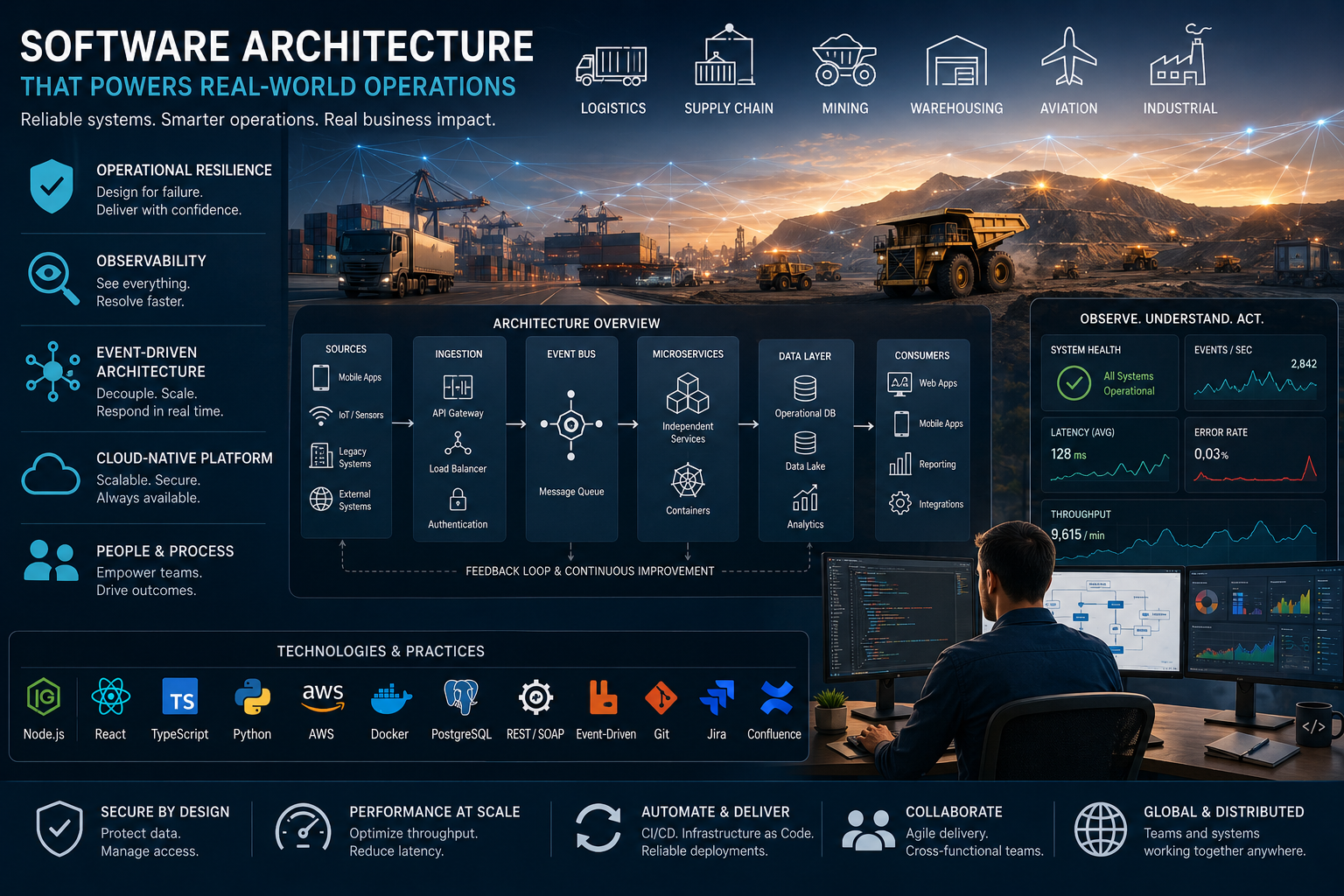
What Mining, Logistics, and Industrial Systems Taught Me About Real Software Architecture
Over the years, one thing became very clear to me:
The hardest engineering problems are usually not about code.
They are about operational trust.
In industries like logistics, transport, mining, warehousing, aviation, and industrial operations, the real challenge is often this:
“How do we make systems reliable enough that people trust operational decisions based on them?”
A delayed telemetry update.
A stale dashboard.
A failed integration.
A duplicated event.
A disconnected field tablet.
A queue backlog nobody noticed.
Those things sound technical.
But operationally, they become business problems very quickly.
One lesson I learned while working across logistics platforms, integrations, APIs, cloud systems, and operational workflows is that architecture discussions should rarely begin with technology choices.
They should begin with operational flow.
Questions like:
• What is the real-world impact of failure?
• Which system is the source of truth?
• What happens when connectivity becomes unstable?
• What can fail safely versus what must never fail?
• How do operators continue working during degraded conditions?
• Where are the bottlenecks in the event lifecycle?
• Which teams actually trust the current data?
Only after understanding those things should architecture decisions happen.
In many operational environments, I have seen that improving observability delivers more value than immediately rewriting systems.
Good observability changes everything.
That includes:
• correlation IDs
• event timestamps
• queue monitoring
• retry visibility
• centralized logging
• latency tracking
• service health visibility
• operational dashboards
Another important lesson is that tightly coupled systems become dangerous at scale.
Modern operational platforms benefit enormously from event-driven thinking.
Instead of one service waiting synchronously on another:
• events are published
• services consume independently
• retries are isolated
• failures degrade gracefully
• operational visibility improves
• scaling becomes easier
This becomes especially important when systems operate across:
• mobile devices
• depots
• industrial yards
• vehicles
• warehouses
• remote operational sites
• intermittent connectivity environments
Real-world systems are messy.
Networks fail.
Data arrives late.
Devices disconnect.
External APIs behave unpredictably.
Operations continue anyway.
That is why practical architecture matters more than theoretical perfection.
One of the biggest mistakes I see in architecture conversations is over-focusing on frameworks while under-focusing on operational reality.
The best engineers and architects I have worked with were usually the people who deeply understood workflows, users, constraints, and failure modes.
Not just the latest tools.
Throughout my career across logistics, eCommerce, enterprise systems, integrations, and cloud-native environments, I have consistently found that the strongest systems are the ones designed around resilience, visibility, and operational usability first.
Technology changes constantly.
Operational principles rarely do.
#SoftwareArchitecture #SolutionsArchitecture #DistributedSystems #EventDrivenArchitecture #CloudArchitecture #SystemsIntegration #EngineeringLeadership #PlatformEngineering #Observability #ReliabilityEngineering #SystemDesign #BackendEngineering #EnterpriseArchitecture #DigitalTransformation #LogisticsTech #MiningTech #CloudNative #API #AWS #TechLeadership

