
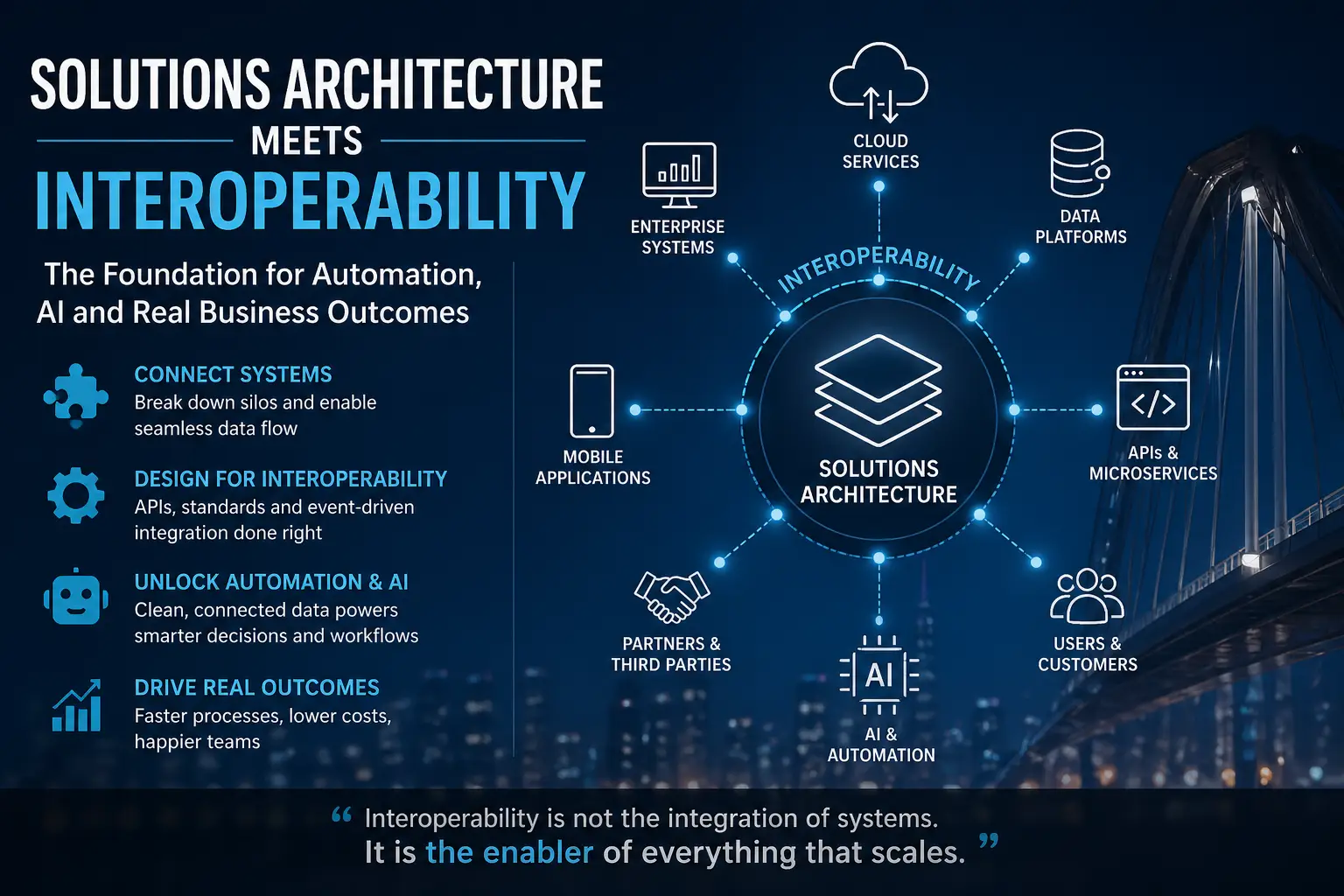
Solutions Architecture has changed. Most companies have not caught up.
For a long time, solutions architecture was about designing systems, choosing technologies, and defining structure.
That is no longer enough.
Today, the real challenge is interoperability.
Most organisations are still operating with:
- disconnected systems
- fragmented data
- manual workarounds between platforms
At the same time, they are investing heavily in AI and automation.
But here is the problem.
AI and automation depend on one thing:
reliable, consistent data flowing across systems.
Without interoperability, that does not exist.
What I have seen in practice is this:
When systems are properly integrated:
- workflows that took hours drop to minutes
- manual coordination disappears
- data becomes usable across the business
When they are not:
- teams rely on spreadsheets, emails, and rework
- automation fails
- AI becomes a surface-level feature instead of a real capability
This is where solutions architecture is evolving.
It is no longer just about system design.
It is about designing how systems work together.
APIs, event-driven patterns, data models, and integration flows are no longer secondary concerns.
They are the foundation.
If interoperability is weak, everything built on top of it is limited.
If it is strong, everything accelerates.
#SolutionsArchitecture #Interoperability #SystemIntegration #APIDesign #EventDrivenArchitecture #Automation #ArtificialIntelligence #DataEngineering #CloudArchitecture #SoftwareEngineering #DigitalTransformation #TechLeadership #EnterpriseArchitecture

