
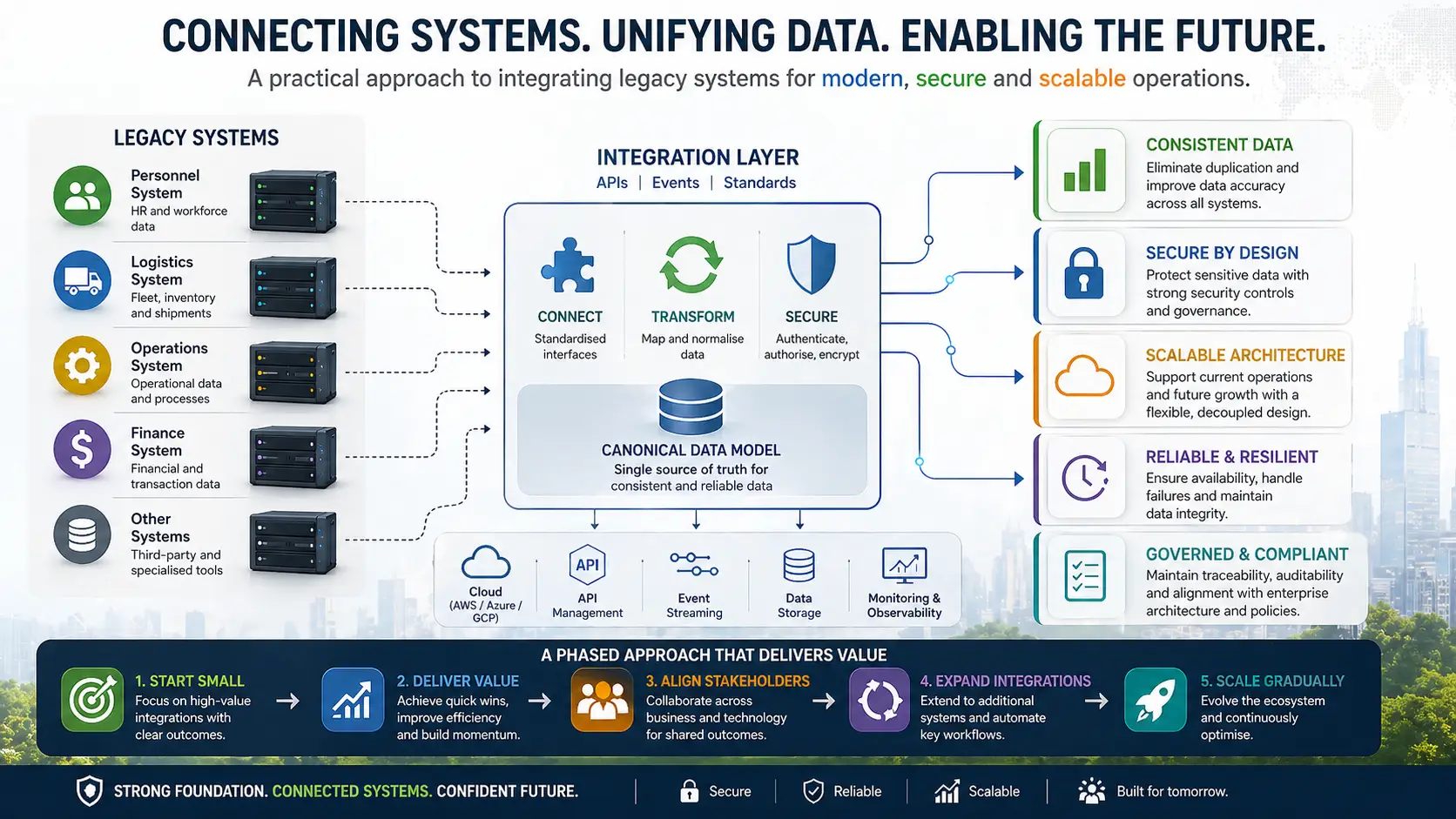
Interoperability Over Replacement: A Practical Approach to Modernising Legacy Systems
Here’s a real-world scenario I’ve been thinking about lately, and it’s one I suspect many organisations are quietly dealing with.
Multiple legacy systems.
Limited integration.
Duplicated data.
Inconsistent reporting.
It’s not unusual. In fact, it’s often the result of years of necessary evolution rather than poor decisions.
If I were asked to walk into this and propose a direction, this is how I would approach it.
First, understand the problem clearly.
We are not dealing with a single broken system. We are dealing with a landscape of systems that were built for purpose at different points in time, now struggling to work together.
The goal is not immediate replacement.
The goal is controlled interoperability.
From there, I would make a few practical assumptions.
These systems are staying, at least in the short term.
The data is sensitive and must be handled accordingly.
And whatever we design must support both current operations and future growth.
The solution itself should not be overcomplicated.
Introduce an integration layer.
This becomes the backbone of communication between systems.
Instead of forcing systems to talk directly to each other, we standardise how they communicate. APIs become the contract. Events become the mechanism for change propagation. A canonical data model helps ensure everyone is speaking the same language.
This reduces tight coupling and allows systems to evolve independently while still participating in a broader ecosystem.
It also opens the door for gradual modernisation, rather than high-risk, large-scale replacements.
Where this approach truly stands or falls is in the details.
Security must be built in from the start. Not added later.
Data consistency must be governed with clear ownership and a defined source of truth.
Scalability must be considered early, not retrofitted.
Reliability must account for failures, retries, and data integrity.
And governance must ensure traceability, auditability, and alignment with enterprise architecture.
There are, of course, trade-offs.
Legacy integration is rarely clean.
Data quality issues will surface.
Stakeholder alignment will take time.
That is why a phased approach matters.
Start with high-value integrations.
Deliver early wins.
Build confidence.
Then expand.
This is not just a technical problem.
It is an architectural, organisational, and operational challenge.
And in my experience, the organisations that succeed here are the ones that treat interoperability as a long-term capability, not a one-off project.
I have seen similar patterns in logistics and integration-heavy environments, where moving from tightly coupled systems to API-driven and event-based architectures significantly reduced manual processing and improved operational flow
The fundamentals have not changed.
Good architecture is still about clarity, control, and careful evolution.
#SolutionsArchitecture #Interoperability #SystemIntegration #EnterpriseArchitecture #APIDesign #EventDrivenArchitecture #DigitalTransformation #LegacySystems #SoftwareArchitecture #EngineeringLeadership #ScalableSystems #DataGovernance

