
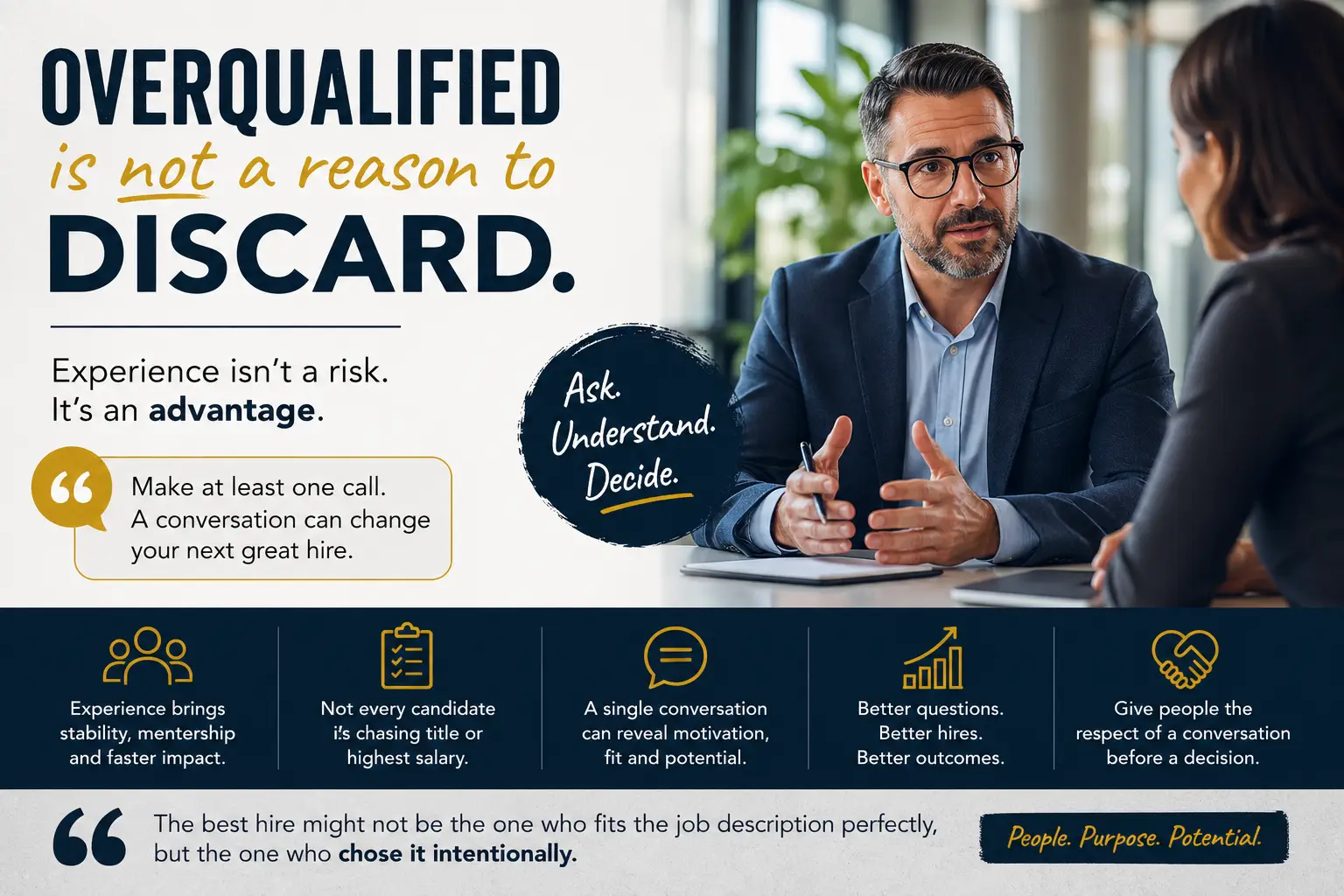
Overqualified or Overlooked? The Cost of Getting Hiring Wrong
There is a growing trend in hiring that deserves to be challenged.
“Overqualified” has quietly become a reason to discard candidates before a real conversation even happens.
That is a mistake.
Not every experienced professional is chasing title, salary, or hierarchy. Many apply for roles because they see stability, alignment, purpose, flexibility, or simply a better fit for where they are in life and career.
Reducing a candidate to an ATS score or a quick scan of years of experience strips away context. It ignores intent. It ignores maturity. It ignores the very thing that experience is meant to bring, judgement.
A professional with 12 plus years across engineering, architecture, delivery, and leadership may apply for a role that appears “below” their last title, but that does not mean they are a risk. In many cases, it means they are making a deliberate decision based on fit, not ego.
What is missing in many hiring processes today is simple:
a conversation.
A single call can answer what a resume cannot:
Why this role
Why now
Why this company
Instead, strong candidates are filtered out by automated scoring, rigid expectations, or assumptions made at first glance.
That approach does not just hurt candidates. It limits organisations from bringing in experienced people who can stabilise teams, mentor others, and deliver with minimal ramp-up.
Overqualification should not be a rejection reason. It should be a signal to ask better questions.
Because sometimes the best hire is not the one who fits the job description perfectly, but the one who chose it intentionally.
#Hiring #Recruitment #ATS #JobSearch #Careers #TalentAcquisition #Leadership #HiringPractices #TechCareers #SoftwareEngineering #EngineeringLeadership #Recruiting #HumanResources #JobSeekers #WorkplaceCulture

