
Designing Scalable Integration for Legacy Systems Without a Full Rewrite
One of the most common challenges I keep seeing across industries is not building new systems, but making existing ones work together.
Recently, I was thinking about a practical scenario:
Multiple legacy systems, each doing their job, but with limited integration. The result is duplicated data, delays, and inconsistent reporting.
The instinct is often to replace everything. In reality, that is rarely feasible.
A more practical approach is to evolve the architecture gradually.
Here is how I typically think about it at a high level.
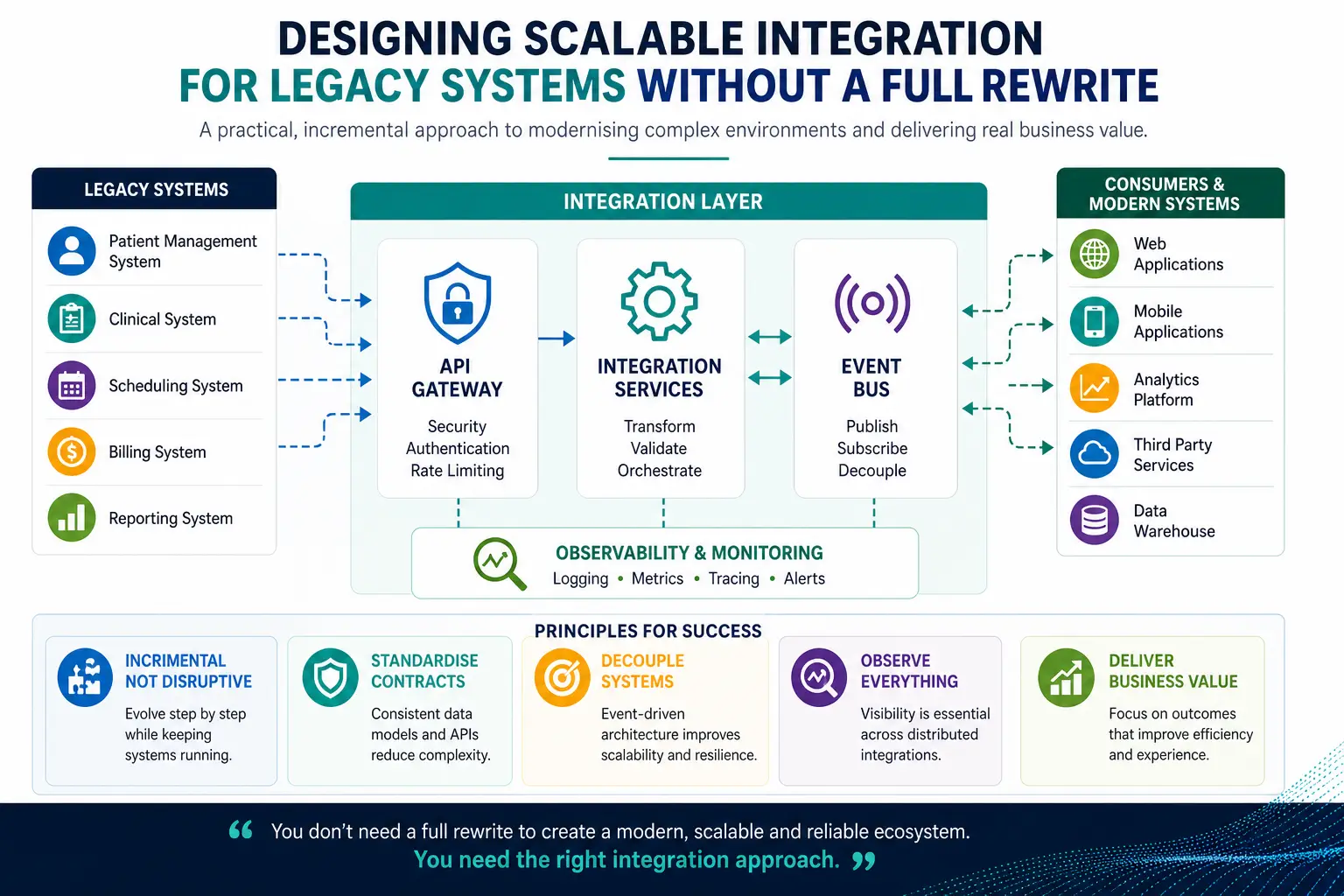
First, establish a clear integration layer. Instead of tightly coupling systems, introduce APIs as the primary communication mechanism.
Second, introduce an event-driven approach where appropriate. Systems can publish and consume events, reducing direct dependencies and improving scalability.
Third, standardise data contracts. Without consistent structures and validation, integration becomes fragile very quickly.
Fourth, focus on observability early. Logging, monitoring, and traceability are essential when multiple systems are interacting.
Finally, avoid the “big bang” rewrite. Incremental improvement almost always delivers better outcomes with lower risk.
This kind of approach allows organisations to modernise while continuing to operate, which is often the real constraint.
Curious to hear how others are approaching legacy integration in their environments.
#SoftwareEngineering #SystemDesign #Architecture #Interoperability #APIs #Microservices #LegacySystems #ScalableSystems #EngineeringLeadership #TechLeadership

