
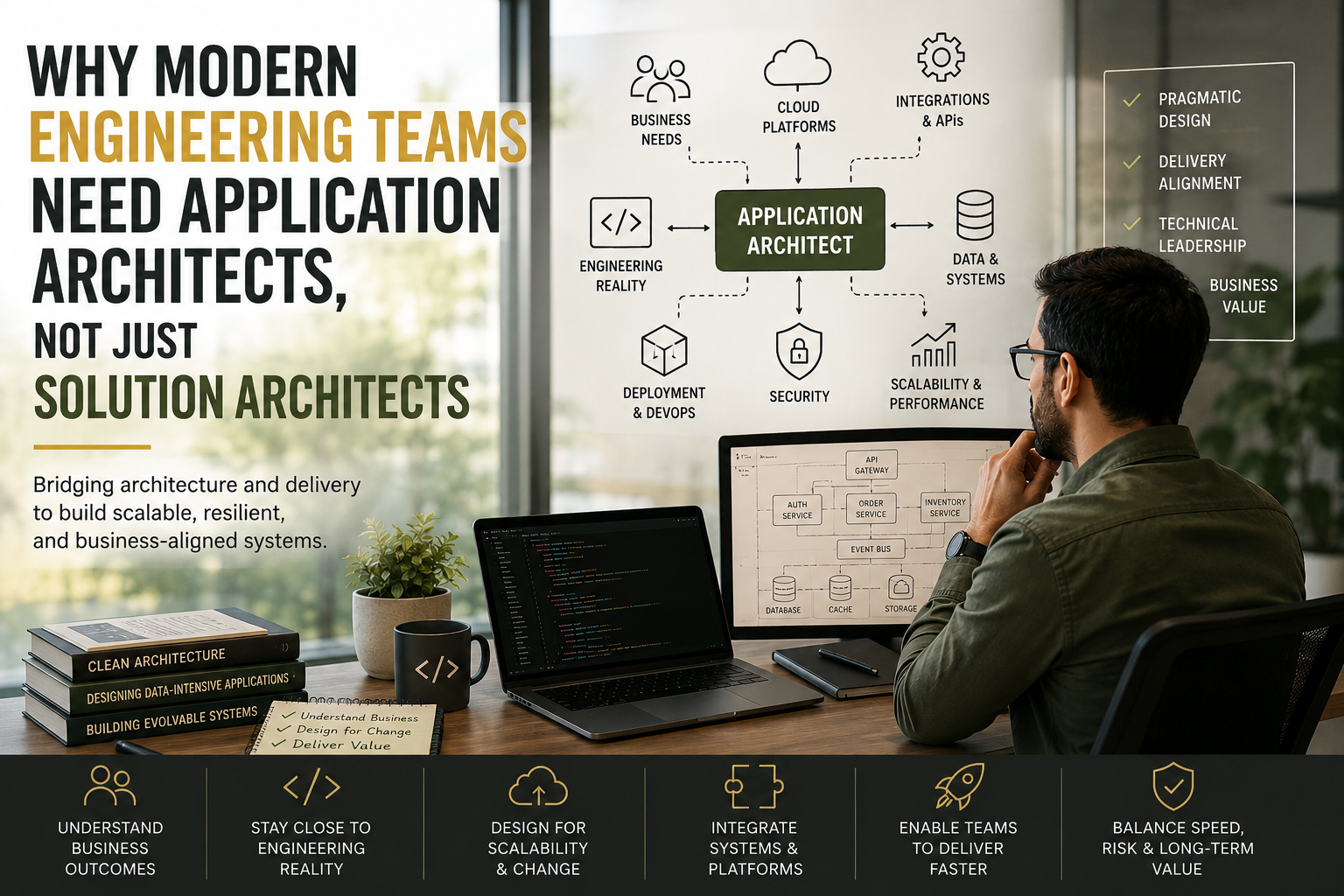
Why Modern Engineering Teams Need Application Architects, Not Just Solution Architects
Over the last several years, one of the biggest shifts I’ve observed across software engineering and enterprise delivery teams is the growing evolution of the “Application Architect” role.
Traditionally, many architecture roles were heavily focused on:
• enterprise governance
• high-level solution modelling
• vendor and platform selection
• documentation and standards
• long-range technology strategy
Those responsibilities are still important.
But modern delivery environments increasingly demand architects who remain much closer to implementation realities and engineering delivery.
In many organisations today, architecture can no longer sit too far away from:
• APIs
• cloud services
• deployment pipelines
• distributed systems
• frontend and backend implementation
• event-driven integration
• operational scalability
• production support realities
The modern Application Architect often operates at the intersection of:
• software engineering
• systems integration
• technical leadership
• business analysis
• delivery enablement
• cloud architecture
• platform evolution
The role is becoming far more pragmatic and delivery-oriented.
In my experience working across logistics platforms, SaaS systems, eCommerce ecosystems, cloud-native applications, and enterprise integrations, the strongest architects are usually the ones who:
• understand implementation trade-offs
• stay technically credible with engineering teams
• understand operational constraints
• can communicate with both business and technical stakeholders
• help reduce delivery friction
• participate in system decomposition and integration strategy
• understand scalability and maintainability from practical experience
• balance speed, technical debt, and long-term sustainability
Modern engineering organisations increasingly expect architects to:
• understand APIs and integrations deeply
• participate in delivery discussions early
• contribute to platform strategy
• guide engineering standards pragmatically
• help teams navigate technical uncertainty
• validate feasibility before major investment
• understand DevOps and cloud-native operational patterns
• support incremental evolution instead of only large “big bang” redesigns
This is especially visible in:
• cloud-native environments
• logistics and operational systems
• API-driven ecosystems
• SaaS platforms
• distributed systems
• integration-heavy enterprises
• microservices-oriented architectures
In these environments, architecture decisions directly affect:
• deployment velocity
• scalability
• maintainability
• operational cost
• integration reliability
• user experience
• engineering productivity
A purely theoretical architecture approach often struggles in fast-moving delivery environments.
The strongest architecture outcomes usually happen when architecture remains connected to:
• engineering reality
• operational workflows
• customer impact
• integration constraints
• business priorities
• delivery capability
Across my own experience, I’ve worked in environments involving:
• multi-tenant SaaS architecture
• logistics interoperability
• cloud-native systems
• API ecosystems
• large-scale operational workflows
• frontend and backend engineering
• AWS-based platforms
• payment and enterprise integrations
• distributed engineering teams
• delivery and platform modernisation initiatives
Many of these environments required architecture decisions that could not be separated from implementation realities.
I believe modern Application Architects increasingly need to combine:
• systems thinking
• engineering depth
• integration knowledge
• business understanding
• delivery pragmatism
• cloud and platform awareness
• stakeholder communication
• operational awareness
Architecture is no longer only about designing systems.
It is increasingly about enabling teams to successfully deliver and evolve systems in real operational environments.
#ApplicationArchitecture #SolutionsArchitecture #SoftwareArchitecture #CloudArchitecture #SystemsIntegration #EngineeringLeadership #SoftwareEngineering #DistributedSystems #APIs #Microservices #SaaS #CloudNative #PlatformEngineering #EnterpriseArchitecture #TechLeadership #AWS #SystemDesign #DigitalTransformation #EngineeringManagement #Interoperability

