
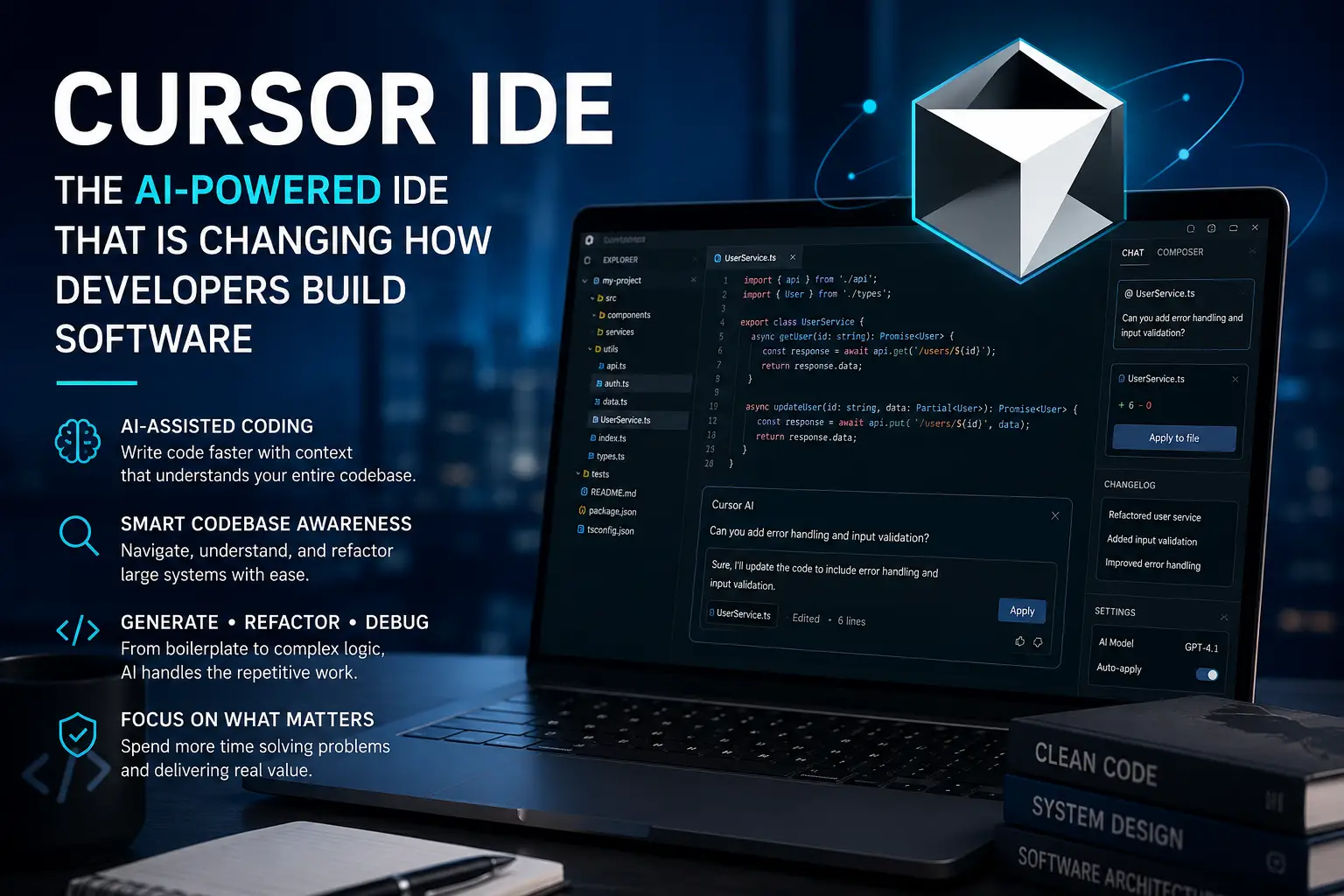
Cursor IDE Is Not Just an Editor. It Is Changing How Software Engineering Works.
For years, developers have improved productivity through better frameworks, tooling, CI/CD pipelines, cloud platforms, containers, and automation.
But AI-assisted development is different.
Tools like Cursor are not simply autocomplete engines. They fundamentally change how engineers interact with codebases, workflows, debugging, architecture, and delivery.
After spending time analysing modern Cursor workflows recently, one thing became very clear:
The biggest productivity gain is not writing code faster.
It is reducing engineering friction.
That changes everything.
Traditional development often looks like this:
- search through files
- trace dependencies manually
- understand legacy code slowly
- review large pull requests line by line
- repeatedly write boilerplate
- constantly switch context
- manually explain workflows to yourself and others
Cursor changes this interaction model completely.
Instead of only editing files, developers now work with the codebase in a conversational way.
Examples of where this becomes extremely powerful:
- understanding unfamiliar systems
- navigating large repositories
- refactoring safely
- generating scaffolding
- accelerating code reviews
- creating tests
- debugging workflows
- reviewing architecture decisions
- identifying duplicated logic
- summarising pull requests
- generating migration scripts
- creating API contracts
- documenting services automatically
One of the most underrated capabilities is context awareness.
Cursor understands relationships across files, services, workflows, APIs, and infrastructure. That becomes incredibly useful in large distributed systems and SaaS platforms where understanding the system is often harder than writing the code itself.
This is especially valuable in environments involving:
- microservices
- event-driven systems
- AI workflows
- distributed architectures
- cloud-native systems
- API integrations
- legacy modernisation
- multi-tenant SaaS platforms
The workflow itself also changes.
Instead of:
“write code manually, then debug later”
The workflow becomes:
- generate
- review
- validate
- refine
- automate repetitive work
- focus engineering effort on risk and decision-making
That distinction matters.
AI tools are not replacing software engineers.
They are amplifying engineers who already understand systems, architecture, trade-offs, security, workflows, and production risk.
The engineers benefiting most from Cursor are usually the ones who already know:
- how systems fit together
- what production risks look like
- where security failures happen
- how APIs break
- how async workflows fail
- how scaling problems emerge
- how bad assumptions enter systems
Because once repetitive engineering effort is reduced, higher-level engineering judgment becomes even more valuable.
Another interesting shift is how Cursor affects code reviews.
Instead of reading every line blindly, engineers can now:
- summarise pull requests
- identify risky flows
- trace changed logic
- highlight side effects
- locate duplicated code
- identify missing tests
- analyse architecture impact
That allows reviews to focus on:
- business logic
- security
- data consistency
- permissions
- integrations
- workflow correctness
- production safety
Which is where the real engineering risk usually exists.
The same applies to testing.
Cursor and similar AI-assisted workflows are extremely useful for:
- unit test generation
- mock generation
- edge case creation
- API test scaffolding
- regression testing ideas
- CI/CD support
- infrastructure templating
The important point is this:
AI accelerates implementation.
Engineering still validates correctness.
That is the future many teams are moving toward now.
And honestly, after years working across SaaS, logistics, cloud systems, APIs, distributed workflows, and platform engineering, it is becoming increasingly obvious that modern engineering teams will eventually operate very differently from how they operated even 3 or 4 years ago.
The real competitive advantage will not simply be “using AI”.
It will be:
- knowing where AI fits safely
- knowing where human judgment is required
- reducing engineering friction
- improving delivery speed without sacrificing quality
- building reliable workflows around AI-assisted engineering
Cursor is one of the clearest examples of that shift happening in real time.
#SoftwareEngineering #CursorIDE #ArtificialIntelligence #AIEngineering #PlatformEngineering #CloudComputing #AWS #DevOps #FullStackDevelopment #TypeScript #Python #Microservices #EventDrivenArchitecture #SoftwareArchitecture #DeveloperTools #EngineeringLeadership #SaaS #ProductEngineering #APIs #DistributedSystems #CodeReview #DeveloperProductivity #AITools #Programming #TechLeadership

