
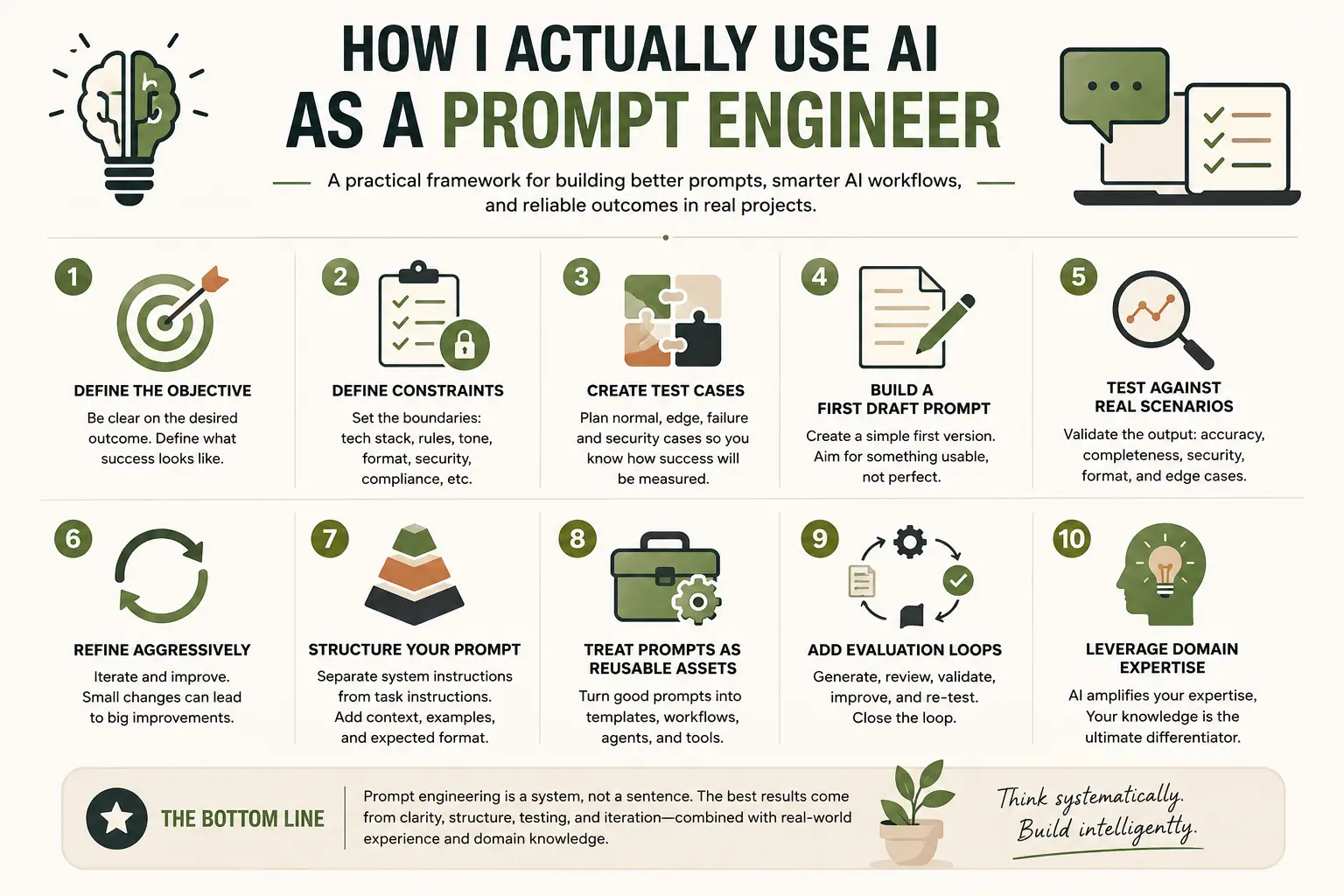
How I Actually Use AI as a Prompt Engineer in Real Projects
A lot of people still think prompt engineering is just “asking ChatGPT better questions”.
It is not.
Good prompt engineering is much closer to software engineering, systems analysis, testing, and iterative design than most people realise.
The biggest mistake I see is people treating prompts as magic sentences instead of structured instructions with measurable outcomes.
When I work with AI systems, agents, copilots, or automation workflows, I usually follow a framework similar to this:
- Define the objective clearly.
What is the actual outcome?
Not:
“Help me with coding.”
But:
“Generate a scalable Node.js API structure with JWT authentication, audit logging, retry logic, and OpenAPI documentation.” - Define constraints.
AI performs better when boundaries exist.
Examples:
technology stack,
security rules,
coding standards,
response format,
tone,
performance requirements,
business rules,
compliance requirements. - Create test cases before refining prompts.
This is the part most people skip.
If you do not know how success is measured, you cannot improve the prompt.
I usually define:
normal cases,
failure cases,
edge cases,
unexpected inputs,
security concerns,
performance expectations.
- Build a first draft prompt.
Do not try to create the “perfect” prompt immediately.
Version 1 should only aim to produce something usable. - Test the output against real scenarios.
This is where prompt engineering becomes engineering.
Does the output:
hallucinate?
miss business rules?
ignore edge cases?
produce insecure logic?
break formatting?
misunderstand domain terminology?
- Refine aggressively.
Most strong prompts are rewritten many times.
Small wording changes can dramatically affect:
accuracy,
reasoning,
structure,
technical depth,
consistency,
and reliability.
- Separate system instructions from task instructions.
One of the biggest improvements comes from structuring prompts properly:
system role,
context,
constraints,
task,
examples,
expected format,
validation rules. - Treat prompts like reusable assets.
Good prompts become:
templates,
internal tooling,
workflow components,
agent instructions,
or entire automation pipelines. - Add evaluation loops.
The real power starts when AI evaluates AI.
For example:
generate,
review,
validate,
improve,
re-test.
That is how you start building reliable AI workflows instead of single-use chatbot interactions.
- Understand that domain knowledge still matters.
AI does not replace expertise.
It amplifies expertise.
A senior engineer, analyst, architect, lawyer, accountant, or logistics specialist will usually get dramatically better results because they understand:
context,
risk,
tradeoffs,
edge cases,
and validation.
Prompt engineering is rapidly becoming a real operational skill across engineering, architecture, analysis, product delivery, operations, research, and business workflows.
The people getting the best results are not necessarily the people writing the longest prompts.
They are the people thinking systematically.
#AI #ArtificialIntelligence #PromptEngineering #SoftwareEngineering #SystemDesign #Automation #AITools #EngineeringLeadership #TechLeadership #MachineLearning #GenerativeAI #AIWorkflows #DigitalTransformation #Productivity #Innovation #Architecture #BusinessAnalysis #CloudComputing #DeveloperTools #FutureOfWork

