
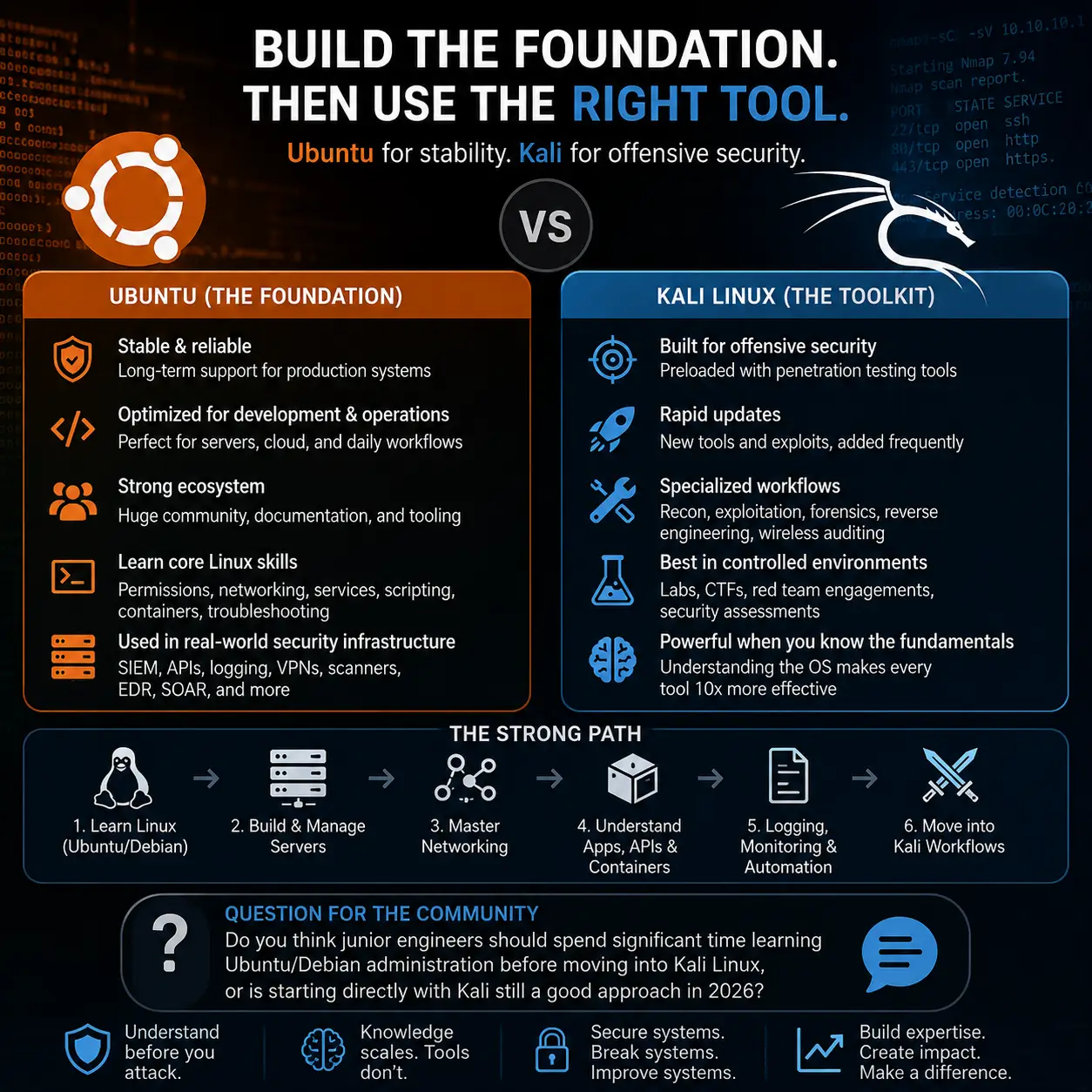
Why Strong Linux Fundamentals Matter More Than Kali Linux Tools
One thing I have noticed over the years in cybersecurity and infrastructure engineering is that many junior engineers jump directly into Kali Linux before properly understanding Linux administration itself.
That usually creates people who know how to execute tools, but not necessarily how to analyse, troubleshoot, secure, or architect systems properly.
In real production environments, most security-related platforms are not running on Kali Linux.
They are commonly deployed on distributions like Ubuntu Server, Debian, Red Hat, or Alpine because organisations need:
- stability
- long-term support
- predictable update cycles
- package consistency
- reproducible environments
- secure CI/CD pipelines
- compliance compatibility
- reliable container orchestration
- easier patch governance
- vendor support
Even a large portion of modern security infrastructure is frequently Ubuntu or Debian-based underneath:
- SIEM platforms
- SOC monitoring stacks
- API gateways
- reverse proxies
- VPN concentrators
- forensic evidence repositories
- internal scanning infrastructure
- EDR management servers
- Docker/Kubernetes security platforms
- logging and observability pipelines
- threat intelligence platforms
- automation/orchestration systems
- cloud-native security tooling
Kali Linux serves a very different purpose.
Kali is essentially a specialised operational distribution designed for:
- penetration testing
- exploit research
- reverse engineering
- malware analysis
- wireless auditing
- red team exercises
- forensic acquisition
- hardware security testing
- vulnerability validation
- protocol analysis
- controlled lab environments
The distinction is important because understanding Linux fundamentals changes how you approach security entirely.
If you already understand:
- filesystem hierarchy
- permissions and ACLs
- SSH hardening
- systemd services
- process management
- networking and routing
- DNS behaviour
- TLS certificates
- Docker and container isolation
- Bash/Python scripting
- package repositories
- kernel modules
- iptables/nftables
- log aggregation
- web servers and reverse proxies
- REST APIs and authentication flows
…then tools inside Kali become significantly more valuable because you understand the infrastructure, protocols, and attack surfaces underneath them.
For example:
- Nmap results become more meaningful when you understand how services bind to interfaces and ports
- Burp Suite becomes more powerful when you understand reverse proxies, JWTs, CORS, and API authentication flows
- Wireshark becomes easier to interpret when you already understand TCP/IP behaviour and routing
- Metasploit becomes safer and more controlled when you understand the target operating system and privilege boundaries
- Web exploitation makes far more sense when you understand how applications are actually deployed in Docker, Kubernetes, Nginx, Apache, or cloud environments
One learning path I still think creates stronger engineers is:
- Learn Linux fundamentals properly on Ubuntu or Debian
- Build and maintain your own servers
- Learn networking deeply
- Deploy applications manually
- Understand APIs, authentication, containers, and logging
- Then move into offensive security workflows with Kali
That progression tends to produce engineers who can both secure and break systems, not just run automated scans.
Question for the cybersecurity and infrastructure community:
Do you think junior engineers should spend significant time learning Ubuntu/Debian administration before moving heavily into Kali Linux, or do you believe starting directly with Kali is still a good approach in 2026?
Interested to hear perspectives from:
- penetration testers
- SOC analysts
- DevSecOps engineers
- cloud engineers
- sysadmins
- infrastructure architects
- malware researchers
- platform engineers
#CyberSecurity #KaliLinux #Ubuntu #Linux #InfoSec #DevSecOps #PenTesting #SOC #CloudSecurity #OpenSource #SecurityEngineering #SysAdmin #Infrastructure #EthicalHacking

