
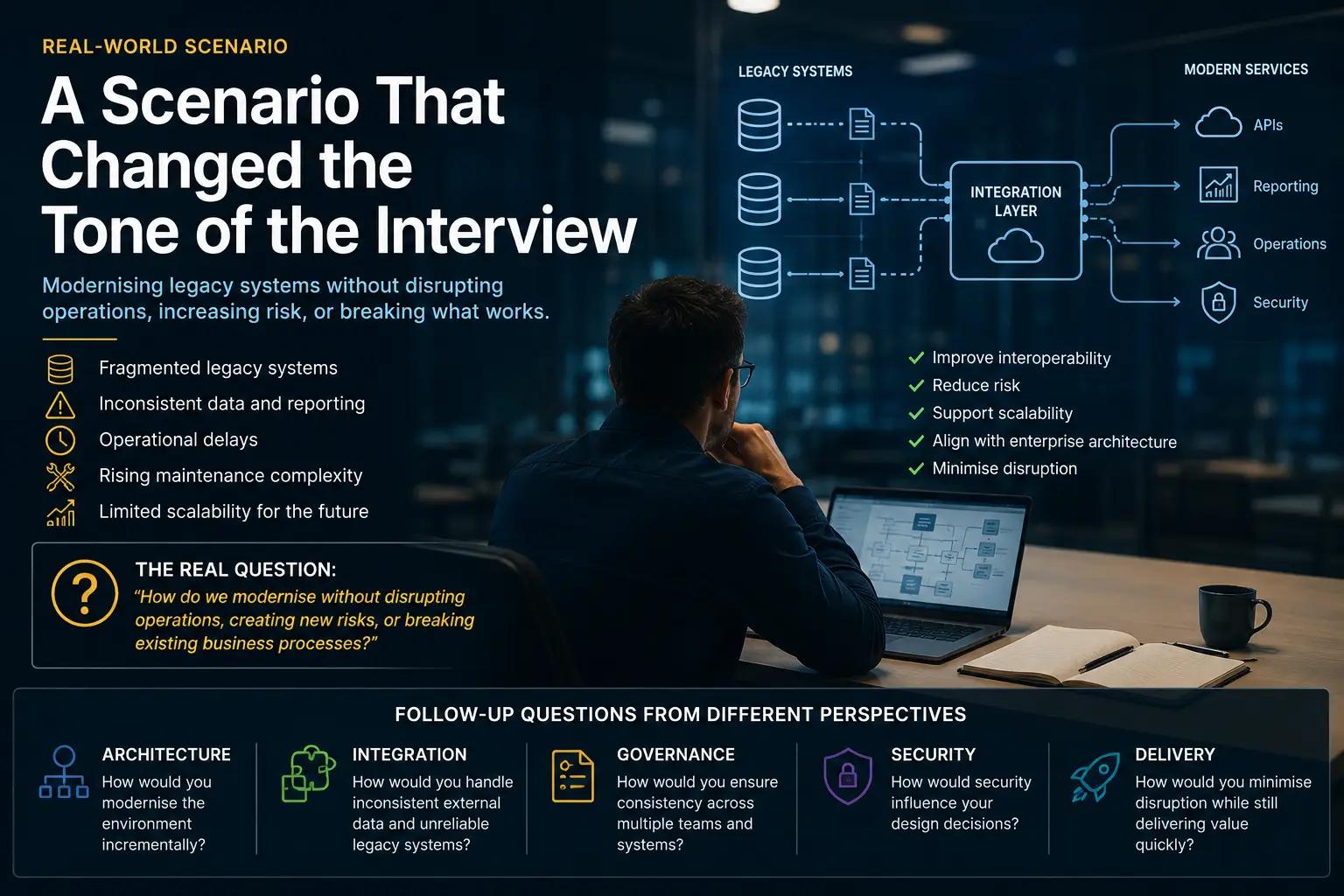
A Scenario That Changed the Tone of the Interview.
A few years ago, I realised that the most interesting technical interviews are rarely about writing code on the spot.
They are usually about how you think when systems, people, risks, and operational realities collide.
One scenario I recently reflected on involved a fictional enterprise organisation struggling with fragmented legacy systems across logistics, reporting, personnel, and operational workflows.
The systems had been built independently over many years.
Different technologies.
Different data formats.
Different ownership.
Minimal interoperability.
The organisation was facing duplicated data, inconsistent reporting, operational delays, and increasing maintenance complexity.
The challenge was not simply:
“How do we modernise the systems?”
The real challenge was:
“How do we modernise without disrupting operations, creating new risks, or breaking existing business processes?”
While presenting a possible approach, the discussion naturally evolved into several follow-up questions from different perspectives.
From an architecture perspective:
“How would you modernise the environment without replacing everything?”
My response focused on incremental modernisation through APIs, integration layers, reusable patterns, and phased delivery rather than large-scale rewrites.
From an integration perspective:
“How would you handle inconsistent external data and unreliable legacy systems?”
The discussion shifted toward validation layers, transformation services, retries, monitoring, and establishing clear ownership and source-of-truth principles.
From a governance perspective:
“How would you ensure consistency across multiple teams and systems?”
That led into architecture standards, governance checkpoints, traceability, documentation, and reusable enterprise patterns.
From a security perspective:
“How would security influence your design decisions?”
The answer centred around secure-by-design principles, access control, auditability, least privilege, segmentation, and operational visibility.
From a delivery perspective:
“How would you minimise disruption while still delivering value quickly?”
The focus became phased implementation, prioritising high-value integrations first, validating progressively, and maintaining operational continuity throughout delivery.
What I find most interesting about these conversations is that strong solution architecture is rarely about finding the most technically impressive answer.
It is usually about balancing:
• business objectives.
• operational reality.
• technical constraints.
• governance requirements.
• long-term maintainability.
The best solutions are often not the most complicated.
They are the ones that are practical, scalable, maintainable, and realistic for the environment they operate in.
#SolutionsArchitecture #EnterpriseArchitecture #SystemsIntegration #TechnicalLeadership #DigitalTransformation #SoftwareEngineering #APIs #CloudArchitecture #EngineeringLeadership #Interoperability #DistributedSystems #TechnologyLeadership #ArchitectureDesign #PlatformEngineering #SystemDesign #Governance #DigitalLogistics #BusinessAnalysis #EngineeringManagement #ScalableSystems

