
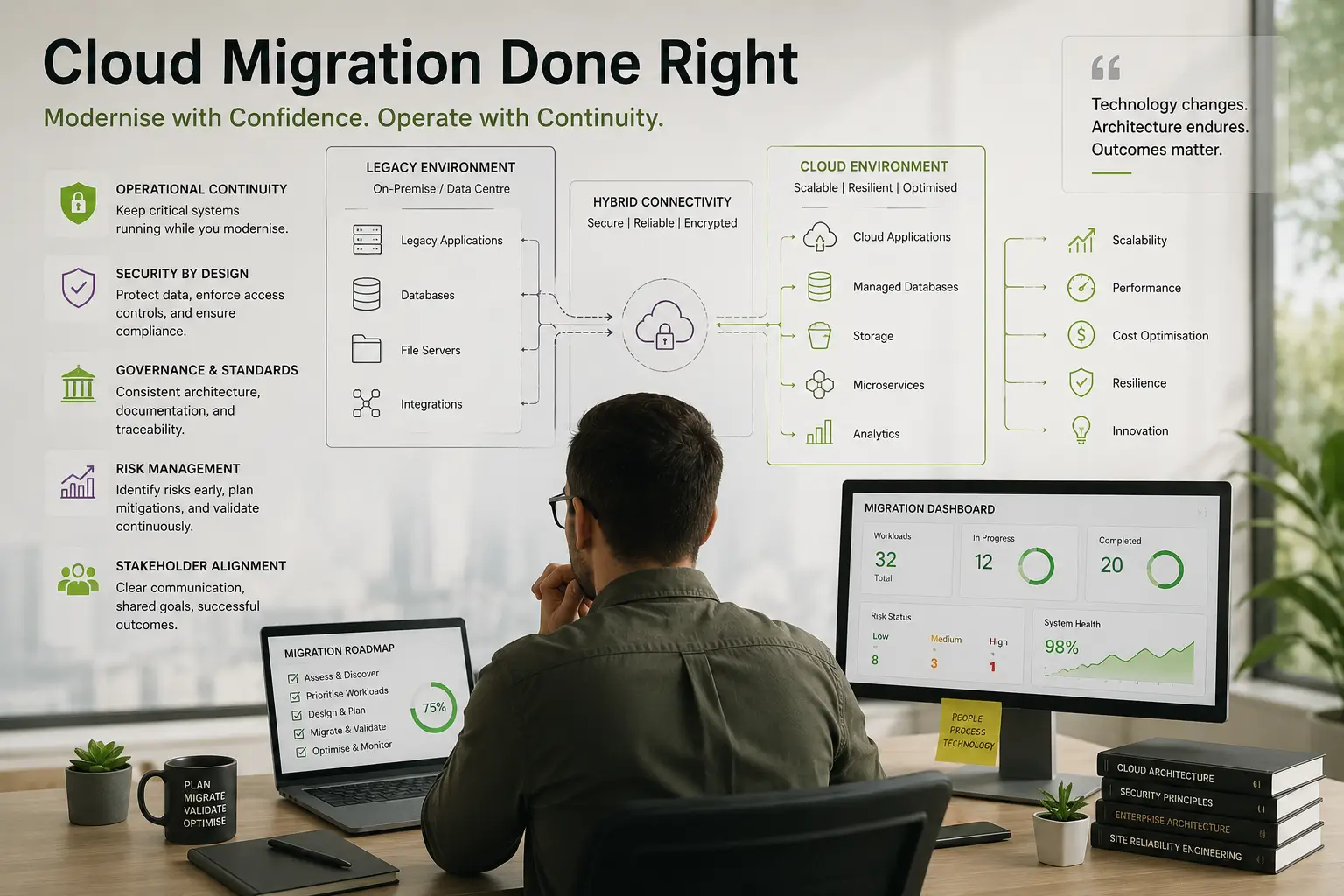
When Cloud Migration Becomes an Operational Risk Problem.
One of the more interesting enterprise architecture scenarios I recently reflected on involved a fictional organisation attempting to migrate several critical systems into a hybrid cloud environment.
At first glance, the problem looked technical.
Legacy infrastructure.
Ageing applications.
High maintenance costs.
Limited scalability.
But the deeper conversation quickly became about operational risk rather than technology alone.
The organisation depended on systems that could not simply be switched off or replaced overnight.
Some supported operational workflows used daily across multiple business units.
Others relied on undocumented integrations, fragile dependencies, and years of accumulated workarounds.
The challenge was not:
“How do we move systems to the cloud?”
The real challenge was:
“How do we modernise safely while maintaining continuity, governance, security, and stakeholder confidence?”
During the discussion, several important questions emerged.
From a cloud architecture perspective:
“How would you approach migration without introducing major operational disruption?”
The response focused on phased migration, hybrid connectivity, prioritising low-risk workloads first, and avoiding large-scale cutover events.
From a governance perspective:
“How would you ensure architectural consistency across multiple teams and vendors?”
The discussion moved toward enterprise standards, reference architectures, governance checkpoints, reusable patterns, and traceability.
From a security perspective:
“How would you handle sensitive systems and secure communications?”
That led into segmentation, least privilege access, auditability, identity management, encrypted communication, and security-by-design principles.
From an operational perspective:
“How would you maintain reliability during migration?”
The focus became rollback strategies, monitoring, observability, progressive validation, failover planning, and maintaining stable business operations throughout delivery.
What stood out again is that successful architecture is rarely about chasing the newest technology.
It is usually about balancing:
• operational continuity.
• governance requirements.
• security constraints.
• delivery practicality.
• long-term maintainability.
The strongest architecture decisions are often the ones users barely notice because the transition feels stable, controlled, and reliable.
That is usually a sign the engineering and architecture teams did their jobs well.
#CloudArchitecture #EnterpriseArchitecture #SolutionsArchitecture #HybridCloud #SystemsIntegration #DigitalTransformation #TechnicalLeadership #CyberSecurity #Governance #SoftwareEngineering #PlatformEngineering #ScalableSystems #OperationalExcellence #EngineeringLeadership #InfrastructureArchitecture #DevSecOps #DistributedSystems #TechnologyLeadership #SystemDesign #CloudMigration

